Effect of Adding Metformin to Standard High Dose Systemic Steroid Therapy in Non-Diabetic Patients With Sudden Sensorineural Hearing Loss
비당뇨 돌발성감각신경성난청 환자에서 표준 고용량 전신 스테로이드 요법에 메트포르민을 병용 투여했을 때의 효과
Article information

Abstract
Background and Objectives
Sudden sensorineural hearing loss (SSNHL) is commonly treated with high-dose systemic corticosteroids, yet recovery remains incomplete in a substantial proportion of patients. Metformin has pleiotropic anti-inflammatory, immunomodulatory, and vascular-protective effects and may mitigate steroid-induced dysglycemia. This study evaluated whether adding metformin to the standard high-dose glucocorticoid therapy improves hearing outcomes in nondiabetic SSNHL.
Subjects and Method
This retrospective observational cohort study included patients treated for idiopathic SSNHL at a single tertiary center (July 2020-July 2025). All patients received oral methylprednisolone of 48 mg/day for 10 days followed by taper; non-responders received intratympanic dexamethasone (up to four injections). The metformin group additionally received metformin of 500 mg/day for 4 weeks. Variable ratio propensity score matching (caliper 0.2) was controlled for age, vertigo, onset-to-treatment interval, and baseline pure-tone average (PTA). Outcomes were changes in the PTA and word recognition score (WRS), and American Academy of Otolaryngology-Head and Neck Surgery Foundation recovery categories. Group-by-time interaction was tested using a linear mixed model.
Results
After matching, 68 patients were analyzed (control n=44; metformin n=24). Both groups showed significant improvement in PTA and WRS; however, between-group differences were not significant (PTA interaction p=0.779; WRS interaction p=0.965). Complete recovery occurred in 43.2% of controls and 33.3% of metformin patients.
Conclusion
In nondiabetic SSNHL, short-term low-dose metformin added to the standard high-dose steroid therapy did not provide additional hearing benefit.
Introduction
Sudden sensorineural hearing loss (SSNHL) is a relatively common condition in otolaryngology and can be diagnosed when hearing loss of 30 dB or more occurs across at least three consecutive frequencies within 72 hours. Although viral infection, vascular compromise, autoimmune disease, and lesions of the inner ear or central nervous system are presumed to act in combination, the exact cause remains unknown in most cases. In Korea, the annual incidence has increased significantly over time, further emphasizing its clinical importance [1,2].
The updated American Academy of Otolaryngology-Head and Neck Surgery Foundation (AAO-HNSF) guideline recommends systemic or intratympanic corticosteroid administration within 2 weeks of symptom onset. Among these agents, glucocorticoids are mainly used and act in the inner ear by reducing tumor necrosis factor (TNF)-α-induced apoptosis [3,4]. High-dose glucocorticoids are required to achieve sufficient concentrations in the perilymph. Because treatment is recommended within 2 weeks of onset, glucocorticoids are often used despite the risk of side effects such as steroid-induced hyperglycemia, increased intraocular pressure, and insomnia. However, even with appropriate glucocorticoid therapy, the hearing recovery rate in SSNHL remains below 70%; moreover, some reports have found no significant improvement compared with placebo, and the use of super-high-dose steroids to increase drug concentrations has not produced consistent favourable outcomes [5-8].
Metformin is an inexpensive treatment for type 2 diabetes mellitus with a long-established safety profile. Beyond glucose lowering, metformin has been reported to have pleiotropic effects, including microvascular protection, improved circulation, anti-inflammatory activity, immunomodulation, and antioxidant effects. Because these effects partly overlap with those of glucocorticoids, metformin has also been proposed as a potential adjunctive therapy for inflammatory or autoimmune diseases [9]. Metformin may suppress hyperglycemia, a metabolic adverse effect of steroids, thereby protecting the inner-ear microvasculature, and may further enhance the anti-inflammatory effects of steroids through an AMP-activated protein kinase (AMPK)-dependent pathway.
In relation to hearing loss, metformin use in patients with type 2 diabetes mellitus has been associated with a lower incidence of hearing loss [10-12]. Laboratory and animal studies have also reported protective effects against cisplatin ototoxicity, noise-induced hearing loss, and post-meningitis hearing loss [13-15]. However, the therapeutic effect of metformin in non-diabetic patients with SSNHL has not yet been reported. Therefore, this study aimed to determine whether adding metformin to high-dose glucocorticoid therapy, which is widely used to treat SSNHL, provides additional improvement in hearing.
Subjects and Methods
Subjects
This retrospective observational cohort study was conducted by extracting and analyzing data from the clinical data warehouse platform of the Big Data Center at Ulsan University Hospital. The study was approved by the Institutional Review Board of Ulsan University Hospital (2026-02-016). We extracted the records of 270 patients who visited the outpatient clinic of the corresponding author between July 2020 and July 2025 and whose primary diagnosis in the Order Communication System was recorded as sudden idiopathic sensorineural hearing loss according to the Korean Standard Classification of Diseases-9 codes H91.2, H91.20, H91.21, or H91.29.
Patients were included in the analysis if they met all of the following criteria: 1) fulfilled the diagnostic criteria for SSNHL, 2) started treatment within 2 weeks of onset, 3) had an affected-side pure-tone average (PTA) of 40 dB or greater using the four-frequency average of thresholds at 0.5, 1, 2, and 3 kHz, 4) had available audiometric results after 1 month of treatment, and 5) received treatment only as outpatients without hospitalization. Patients were excluded if they 1) had already received high-dose steroid treatment for SSNHL for more than 1 week at another hospital before presentation, 2) did not receive systemic steroids because of diabetes mellitus, glaucoma, schizophrenia, or other conditions, 3) were diagnosed with vestibular schwannoma on magnetic resonance imaging, 4) had acute or recurrent low-frequency hearing loss, 5) had a clear precipitating factor immediately before onset, such as head trauma, acoustic trauma, or a sudden intracranial or external pressure change, 6) had mixed hearing loss, 7) had a history of recurrent hearing loss in the affected ear, 8) had preexisting asymmetric hearing between both ears, or 9) had SSNHL occurring simultaneously in both ears.
Study and control groups
The control group consisted of patients who received conventional high-dose glucocorticoid therapy from July 2020 to May 2024. The metformin group consisted of patients who received additional metformin from June 2024 to July 2025 based on the attending physician’s clinical judgment, considering its potential to suppress steroid-induced hyperglycemia, as well as its anti-inflammatory and inner-ear protective effects. Patients with diabetes mellitus or those who refused metformin were not included in the metformin group. Before prescription, all patients were fully informed of the purpose of using the drug in non-diabetic patients and its potential adverse effects. Metformin was administered only to patients who agreed to receive it. Except for metformin administration, the same treatment protocol was applied to both groups.
Glucocorticoid therapy consisted of oral methylprednisolone (Methylprednisolone, Methylon Tab. 4 mg®; Alvogen Korea) at 48 mg per day for 10 days, followed by tapering over 4 days. As adjunctive medication, Ginkgo biloba extract 80 mg (Ginexin-F Tab. 80 mg®; SK Chemicals) was administered orally twice daily for 2 weeks. If audiometry performed after 1 week showed less than a 10 dB improvement or the patient reported partial but unsatisfactory recovery, a total of four intratympanic steroid (dexamethasone, Yuhan Dexamethasone Disodium Phosphate Injection®; Yuhan Corp.) injections were administered over a 2-week period. In addition to this protocol, the metformin group received an additional 500 mg per day of oral metformin (Yuhan Metformin XR Tab. 500 mg®; Yuhan Corp.) for 4 weeks (Fig. 1). Neither group received other treatments, including hyperbaric oxygen therapy, stellate ganglion block, Carbogen inhalation, or lipoprostaglandin E1.
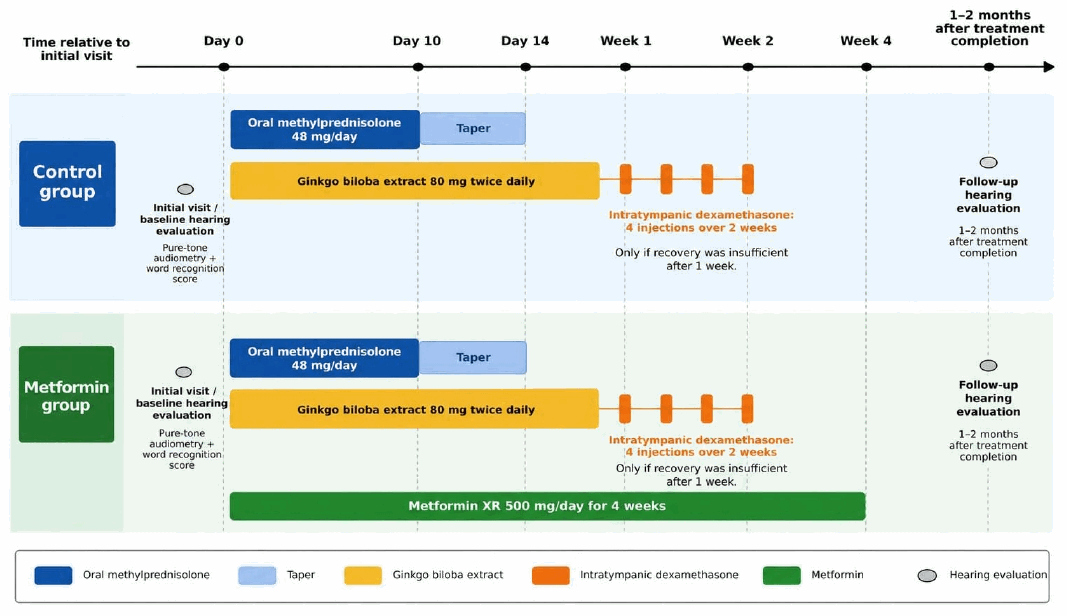
Treatment and assessment timeline.
Outcome analysis
Hearing outcomes at the initial visit and at 1–2 months after completion of treatment were compared using PTA and word recognition score (WRS). The degree of hearing recovery was classified according to the recommendation of the updated AAO-HNSF guideline. Complete recovery was defined as recovery to within 10 dB of the unaffected ear and within 5%-10% of the contralateral WRS. Partial recovery with serviceable hearing was defined as an improvement of 10 dB or more or an improvement in WRS of 10% or more, with a final WRS greater than 50%. Partial recovery with non-serviceable hearing was defined as a final WRS of 50% or lower despite an improvement of 10 dB or more. No recovery was defined as hearing recovery of less than 10 dB [3].
Statistical analysis
To reduce bias and potential confounding between the metformin and control groups, we adjusted for five variables: age, accompanying dizziness, time from onset to treatment initiation, pretreatment PTA, and pretreatment WRS. Differences in baseline characteristics were adjusted using variable-ratio propensity score matching (PSM) based on the nearest-neighbor method with a greedy matching algorithm, in which patients were sorted according to the estimated propensity score. A caliper of 0.2 was applied to the distance between estimated propensity scores, and subjects outside the caliper were excluded from subsequent analyses. To assess balance between the two groups, the standardized mean difference (SMD) was calculated. An absolute SMD of less than 0.2 was defined as indicating clinically well-balanced baseline characteristics between the groups [16]. Within propensity score-matched pairs, outcomes were compared using generalized estimating equations for categorical variables and mixed-effects models for continuous variables, with both methods accounting for clustering within matched pairs. PSM was performed using R software 4.1.2 with the MatchIt package (R Foundation for Statistical Computing; www.r-project.org). Differences in changes in hearing outcomes according to metformin use were analyzed using a linear mixed model in SPSS version 24 for Windows (IBM Corp.), and the interaction p value was assessed. A p value of less than 0.05 was considered statistically significant.
Results
Baseline characteristics
Of the 270 patients screened, 108 met the inclusion and exclusion criteria. Among them, 26 were classified into the metformin group and 82 into the control group. No patient was excluded from the study because of metformin-related adverse effects or refusal to take metformin. After variable-ratio PSM, there were no significant differences in any variables between the control and metformin groups. The absolute SMD was less than 0.2 for all variables, confirming that the baseline characteristics were well balanced after matching (Table 1). After PSM, a final cohort of 68 patients with similar baseline characteristics in terms of age, accompanying dizziness, time from onset to treatment initiation, pretreatment PTA, and pretreatment WRS was selected. This cohort included 24 patients in the metformin group and 44 in the control group (Fig. 2). The mean age of the analyzed patients was 55.7 years, and the pretreatment PTA was 69.9 dB (Table 1). Intratympanic steroid injection was performed in 14 of 24 patients in the metformin group and in 31 of 44 patients in the control group.
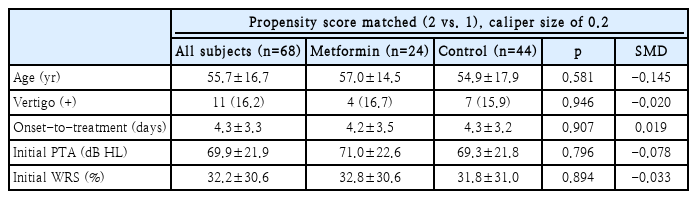
Characteristics of the study subjects after propensity score matching
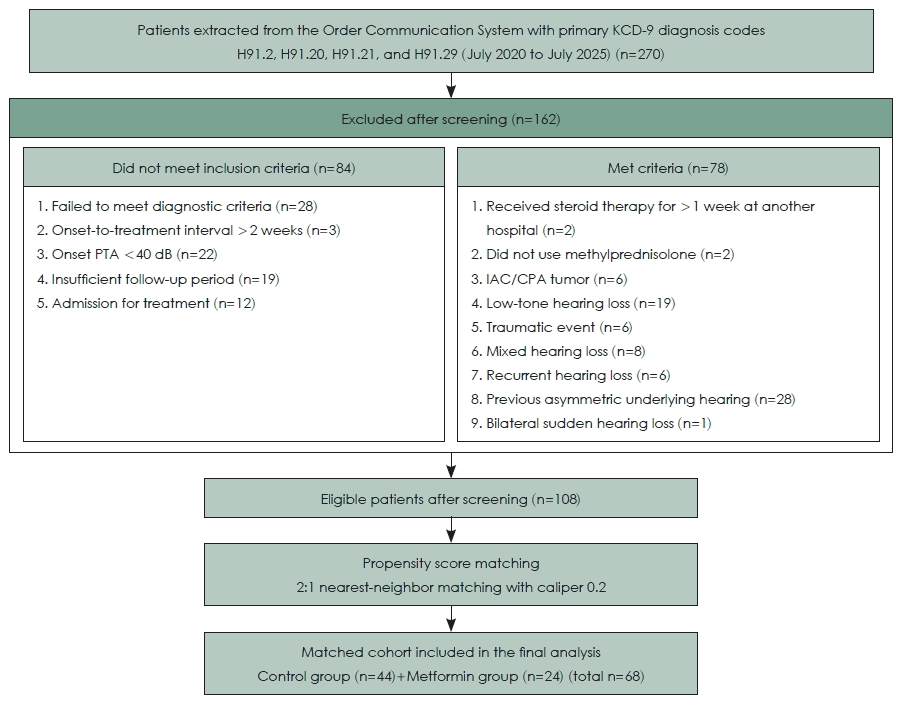
Flow diagram of patients selection and propensity score matching. KCD-9, Korean Standard Classification of Diseases-9; PTA, pure-tone average; IAC, internal auditory canal; CPA, cerebellopontine.
Scatter plots showing post-treatment changes in PTA and WRS in each group, as well as the mean pure-tone thresholds at each frequency, are shown in Figs. 3 and 4. After treatment, the PTA improved significantly by a mean of 29.2 dB in the metformin group and 27.6 dB in the control group, with no between-group difference. The WRS improved by a mean of 35.7% in the metformin group and 35.3% in the control group, with no between-group difference after treatment (Fig. 5). Changes in PTA according to metformin use did not differ between the groups (interaction p=0.779), nor did changes in WRS (interaction p=0.965) (Fig. 6). According to the hearing recovery classification recommended by the updated AAO-HNSF guideline, 70.8% of patients in the metformin group showed partial recovery or better, and 33.3% achieved complete recovery. In the control group, 79.5% showed partial recovery or better, and 43.2% achieved complete recovery, with no between-group difference (Table 2). Based on the observed effect size (w≈0.265) from the Pearson chi-square test (χ2=4.785, df=3, N=68, α=0.05), the exploratory post-hoc power was approximately 42%.
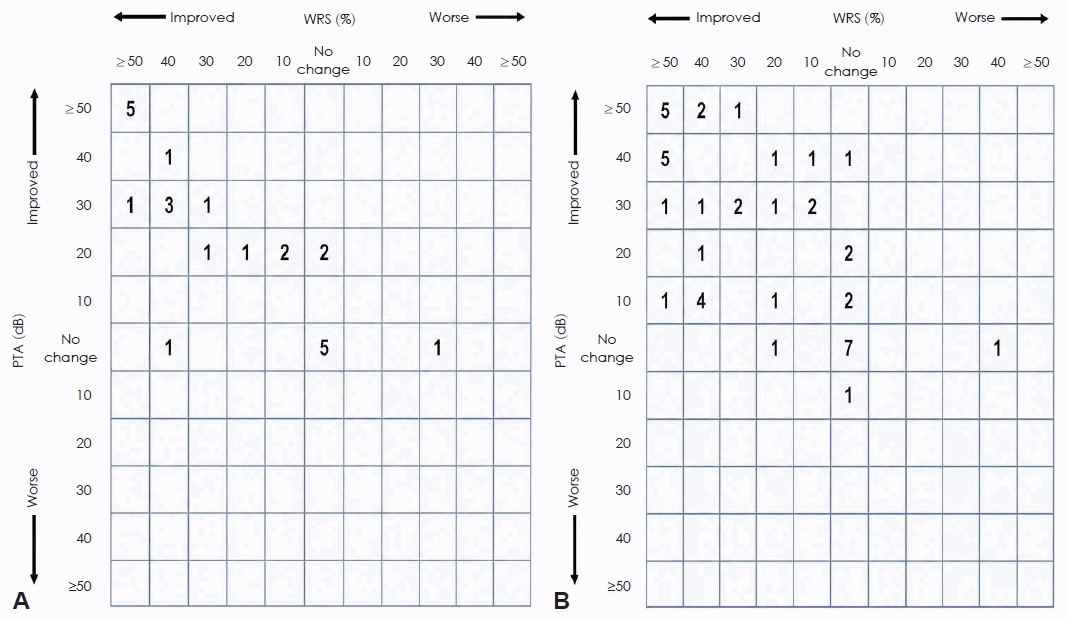
The scattergram of post-treatment change of audiogram for metformin group (A) and control group (B) using pure-tone audiogram (PTA) and word recognition score (WRS). Many patients in both groups showed improved hearing after treatment, as represented in the boxes in the upper left quadrant.
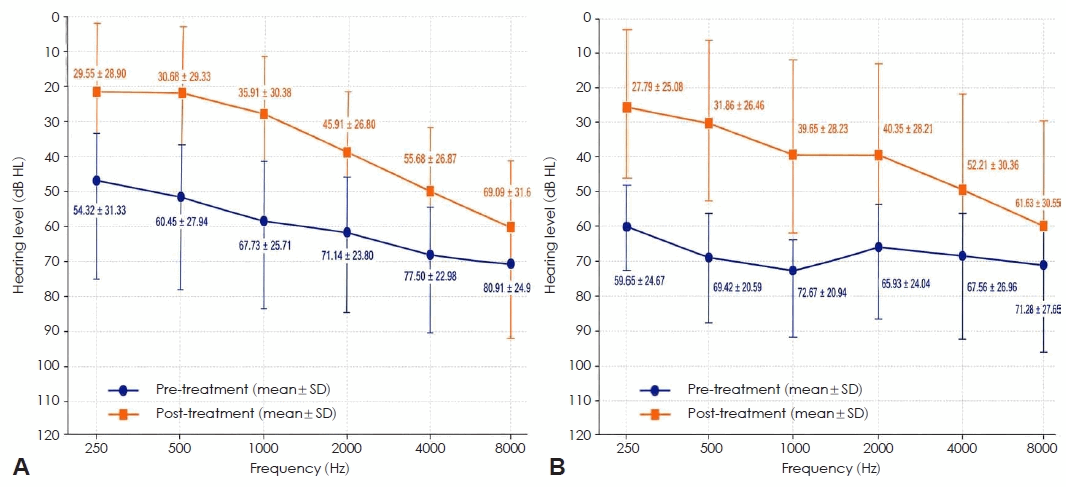
Comparison of the mean hearing thresholds across frequencies before and after treatment. Data are presented as mean±standard deviation for the metformin and control groups. A: Metformin group: pure tone audiogram before and after treatment. B: Control group: pure tone audiogram before and after treatment.
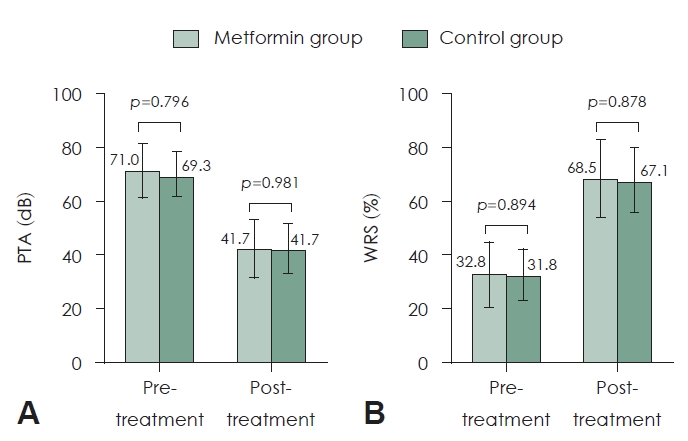
A comparison of the pre- and post-treatment pure-tone audiograms (PTA) (A) and word recognition score (WRS) (B). There was no significant difference in the pre- and post-treatment audiogram between the two groups.
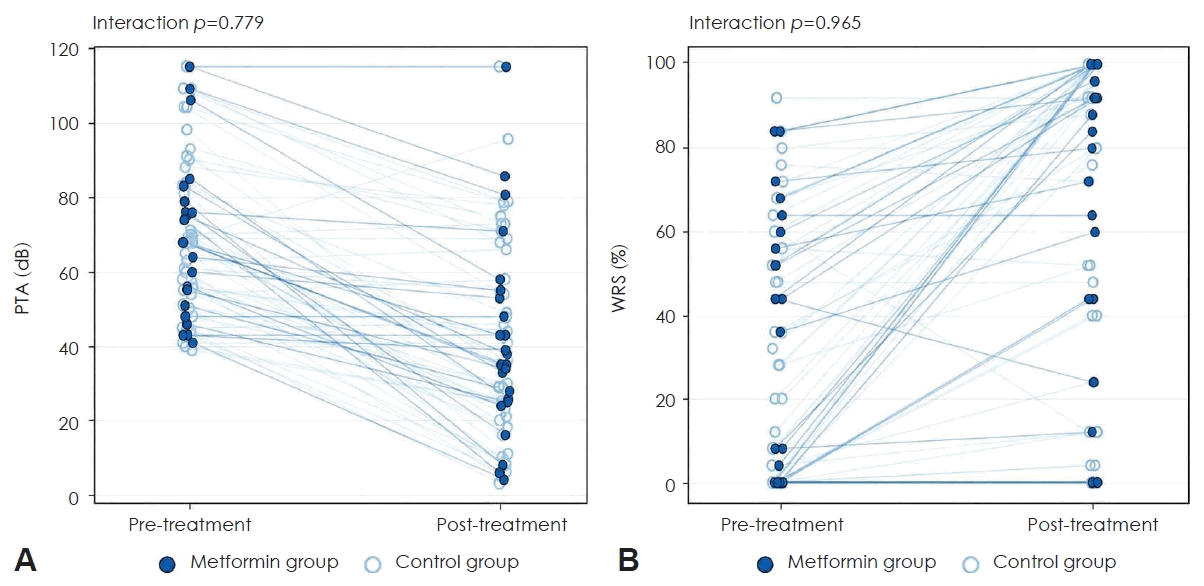
Paired plots of pure-tone average (PTA) (A) and word recognition score (WRS) (B) before and after treatment in the metformin and control groups. Each dot represents an individual patient; lines connect pre- and post-treatment measurements within the same patient. The interaction p value corresponds to the group×time term from a repeated-measures model evaluating differential change between groups.
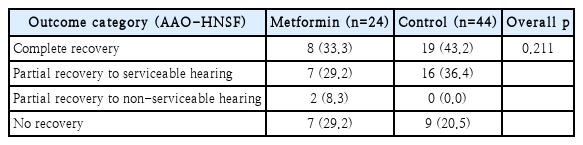
Comparison of treatment outcomes according to AAO-HNSF clinical practice guideline: sudden hearing loss (update)
Discussion
In this study, adding metformin to conventional high-dose steroid therapy did not provide additional hearing improvement in non-diabetic patients with SSNHL.
The possible etiologies of SSNHL include a combination of factors, such as viral infections, autoimmune diseases, microvascular disorders, and oxidative stress. Glucocorticoids are expected to work through anti-inflammatory, immunosuppressive, antioxidant, and anti-apoptotic actions, and are therefore used worldwide for the treatment of SSNHL [17].
Metformin is also known to exert anti-inflammatory, immunomodulatory, and antioxidant effects by inhibiting NF-κB, mTOR, TNF-α, CEBP-homologous protein (CHOP), ICAM1, COX-2, and other pathways through AMPK-dependent and AMPK-independent mechanisms [18]. These effects, which overlap with those of glucocorticoids, suggest the potential utility of metformin as a treatment for SSNHL. Nevertheless, metformin combination therapy did not improve hearing outcomes in this study, and several explanations may be considered.
First, a ceiling effect may have limited the additional benefit of metformin. Glucocorticoids and metformin have overlapping therapeutic mechanisms, including anti-inflammatory, immunosuppressive, and antioxidant effects, but glucocorticoids produce relatively potent and rapid responses. Through glucocorticoid receptors in cochlear cells and immune cells, glucocorticoids regulate the transcription of numerous genes, suppress early inflammatory responses, and exert some anti-inflammatory effects within minutes through non-genomic mechanisms [19]. Therefore, in cases driven by inflammatory pathology, glucocorticoids may have already induced a rapid and sufficient therapeutic response, leaving less room for additional benefit from metformin. In contrast, the mechanisms of metformin extend beyond short-term suppression of acute inflammation and include inhibition of reactive oxygen species, long-term restoration of vascular endothelial function, and metabolic reprogramming of cells. Several weeks to months may be required before these structural and neuroprotective effects at the cellular level become detectable as threshold improvement on audiometry. In patients with rheumatoid arthritis, metformin has been reported to require at least 6 months of administration to significantly reduce serum C-reactive protein (CRP) levels and disease activity, suggesting that long-term use may be necessary to achieve a pronounced anti-inflammatory effect in humans [20]. Because the recovery period for SSNHL is relatively short—with 90% of patients reaching their final hearing level within the first month of treatment and 98.3% reaching it by the third month [3], short-term coadministration of metformin alone may not have produced sufficient biological change.
Second, because the immunomodulatory effect of metformin is dose-dependent, the 500 mg daily dose used in this study, which is the minimum therapeutic dose, may have been insufficient [21]. The metformin doses used in animal and in vitro studies are approximately 10-100 times higher than clinically used human doses. Studies have been conducted to confirm the cancer-preventive effects in non-diabetic patients. Various doses ranging from 250 to 1,700 mg per day were administered, but most studies used higher doses than our study [22]. Although animal studies have demonstrated cochlear protection by metformin at high doses per unit body weight [14,15], it cannot be ruled out that the minimum daily dose of 500 mg used in this study was insufficient to achieve an effective intracochlear concentration for protection. However, it is not ethically desirable to administer a higher dose of metformin to non-diabetic patients without sufficient proof of better hearing recovery. In addition to the gastrointestinal adverse effects of high-dose steroids, such as heartburn, dyspepsia, and an increased risk of gastric ulcers, metformin can cause gastrointestinal adverse effects, including nausea and vomiting, in a dose-dependent manner [22]. Metformin is generally initiated at 500 mg daily and increased at 1- to 2-week intervals with glucose monitoring, but dose escalation in non-diabetic patients may carry a risk of hypoglycemia.
The prevalence of steroid-induced hyperglycemia has been reported to be as high as 32.3% [23]. Therefore, adding metformin to conventional, high-dose steroid therapy may offer potential advantages, even if it does not improve hearing, but this requires separate investigation.
This study has several limitations. First, although PSM was performed for covariates known to affect prognosis, this was a retrospective observational cohort study, and indicators related to metabolic syndrome, such as body mass index, lipid profile, and insulin resistance, were not available. Because the prognosis of SSNHL is relatively poor in patients with metabolic syndrome [24], and because metformin has been reported to reduce CRP and tissue plasminogen activator levels compared with placebo in patients with high-risk factors for diabetes [25], metformin may have potential to improve hearing in patients with metabolic syndrome risk factors. Second, the dose and duration of metformin administration may have been insufficient, which may have underestimated the potential effect of metformin. Third, the analyzed follow-up period was relatively short at 1-2 months after treatment completion, which may have been insufficient to fully evaluate long-term recovery of neural plasticity induced by metformin and the resulting delayed recovery effect. Fourth, because the final sample size after PSM was small and statistical power was limited, the possibility of type II error cannot be excluded. Therefore, validation through a large prospective randomized controlled trial with sufficient sample size and statistical power is required. Fifth, there was a difference in the patient recruitment and treatment periods between the control group (2020-2024) and the metformin group (2024-2025). Although the study was conducted at a single center by the same attending physician using the same standard protocol except for metformin, and although baseline characteristics were adjusted through PSM, the possibility of temporal bias remains.
In conclusion, in non-diabetic patients with SSNHL, short-term addition of metformin to standard steroid therapy did not show additional benefit in hearing improvement or recovery outcome. To date, the clinical value of metformin for hearing protection appears to lie more in prevention than in acute treatment. Short-term administration of a minimal dose of metformin after the onset of SSNHL may be insufficient to restore hearing once acute ischemic and inflammatory damage is already underway in the inner ear. Future studies should explore the dose-response relationship by gradually increasing metformin within a safe range or by evaluating multiple dose groups.
Supplementary Materials
The Supplement is available with this article at https://doi.org/10.3342/kjorl-hns.2026.00234.
Notes
Acknowledgments
None
Author Contribution
Conceptualization: Joong Keun Kwon. Data curation: Joong Keun Kwon. Formal analysis: Joong Keun Kwon. Investigation: Jae Won Jang, Hyeon Seok Goo. Methodology: Joong Keun Kwon. Supervision: Joong Keun Kwon. Validation: Jae Won Jang, Hyeon Seok Goo. Visualization: Jae Won Jang, Hyeon Seok Goo. Writing—original draft: Jae Won Jang. Writing—review & editing: Hyeon Seok Goo, Joong Keun Kwon.