Benefits of Active Noise Canceling to Prevent Excessive Noise Exposure Via Personal Listening Devices
개인용 청취기기 사용 시 과도한 소음 노출 예방을 위한 능동 소음 제거의 효과
Article information

Abstract
Background and Objectives
The use of personal listening devices (PLDs), particularly wireless earbuds, has increased substantially, raising concerns about noise-induced hearing loss as users often raise volumes in noisy environments. Many recent earbuds are equipped with active noise canceling (ANC) technology. This study aimed to evaluate the effectiveness of ANC in four popular wireless earbud models using both subjective and objective methods in simulated noisy conditions.
Subjects and Method
A total of 47 participants with normal hearing completed listening tests each using the earbud under ANC ON and ANC OFF conditions. Preferred listening levels (PLLs) were obtained under bus and café noise conditions, and real-ear measurements (REMs) were obtained under bus noise. Two-way repeated-measures analysis of variance was used to compare PLLs and REMs across ANC conditions and earbud types.
Results
Significant interaction effects between earbud type and ANC status were observed for both PLLs (p<0.001 in bus noise; p=0.003 in café noise) and REMs (p<0.001 at low and whole frequencies; p<0.001 at high frequencies). Among the four models, earbuds C and D showed greatest reductions in both volume levels and ambient noise.
Conclusion
Although ANC performance varied slightly between models, overall, ANC was effective in reducing PLLs and real-ear sound levels in noisy environments. These findings suggest that ANC-equipped wireless earbuds may help reduce potential sound exposure during PLD use; however, further longitudinal studies with audiometric outcomes are needed to determine whether these reductions translate into long-term hearing protection.
Introduction
The use of personal listening devices (PLDs) among adolescents and young adults has increased, raising concerns about noise-induced hearing loss [1-3]. According to an international standard (ISO-1999), the risk of noise-induced hearing loss is considered negligible only when the A-weighted equivalent continuous sound pressure level (LAeq) does not exceed 85 dB during prolonged exposure. Furthermore, various organizations, such as the Occupational Safety and Health Administration, the National Institute for Occupational Safety and Health, and the World Health Organization, have proposed exposure limits based on an 8-hour exposure, setting thresholds at 90, 85, and 75 dB LAeq, respectively. As sound levels increase beyond these thresholds, the allowable exposure duration decreases accordingly [4-6]. Given that sound levels in modern daily environments often range between 75 and 87 dB LAeq, prolonged exposure may exceed recommended safety thresholds [1,7,8]. In addition, the use of PLDs in noisy environments may contribute to increased volume levels to receive target signals more clearly in the presence of background noise. This can lead to excessive noise exposure and potentially cause noise-induced hearing loss. The association between noise-induced hearing loss and the use of PLDs in adolescents and young adults has been established in previous studies [9-13].
The active noise canceling (ANC) function of PLD technology may help to address this issue. ANC technology improves the signal-to-noise ratio (SNR) in noisy environments using microphones and speakers [14]. By reducing the need for high-volume listening in noisy environments, ANC can act as a potential preventative measure against self-induced noise exposure [15-17]. PLDs equipped with ANC are widely used for listening to music but also can be used for lectures or work purposes.
Among PLDs, wireless earbuds are the most commonly used device due to their ease of use and portability [18]. However, in-the-canal type earbuds deliver sound more directly to the ear and are more likely to introduce excessive noise compared to conventional speakers. Therefore, the latest wireless earbuds feature an ANC function, and manufacturers continue to launch products with more advanced ANC technology. However, there is limited evidence on the efficacy of these technologies to improve target sound detection. To bridge this gap, we evaluated both earlier and recent ANC technology in wireless earbuds and assessed their performance in real-world listening situations.
Previous studies have explored the impact of ANC technology on preferred listening levels (PLLs) and real ear measurements (REMs) in noisy environments [19,20]. Findings suggest that ANC earphones effectively reduce background noise, particularly in the low-frequency range, leading to significantly lower PLLs and potentially minimizing the risk of noise-induced hearing loss. Among various earphone types, canaltype ANC earphones demonstrate the most substantial noise attenuation, emphasizing their role in promoting safer listening practices. However, these studies had small sample sizes and were conducted using older generation ANC technologies. To address these limitations, we assessed the effectiveness of ANC technology featured in the latest wireless earbuds with a larger sample size in more realistic noisy environments. We aimed to evaluate the effectiveness of the latest ANC technology in noisy environments by quantifying the level of noise reduction when using ANC to estimate its impact on hearing preservation in real-world noisy environments.
Subjects and Methods
Study participants
A total of 47 normal hearing young adults (20 males, 27 females) participated in this study. The inclusion criterion was individuals with a pure-tone average (PTA) less than 25 dB HL across the frequencies of 500, 1000, 2000, and 4000 Hz, and they had no severe mental or physical disabilities. None of the participants had a diagnosed history of tinnitus, hyperacusis, or other otologic disease. All participants had hearing thresholds within normal limits (≤25 dB HL) at all octave frequencies from 250 to 8000 Hz in both ears. PTAs were 7.71 dB HL for the right ear and 6.38 dB HL for the left ear. The demographics of the study participants are provided in Table 1. We estimated the required sample size a priori using G*Power 3.1.9.4. Based on a previous study using a similar PLL/REM paradigm [17], a medium effect size was assumed (f=0.25) for the sample size calculation. For a two-way repeated-measures analysis of variance (RM ANOVA) with two within-subject factors, earbud type (four levels) and ANC status (two levels), resulting in eight repeated-measure conditions, the required sample size was 16 when α was set at 0.05, statistical power at 0.80, and the correlation among repeated measures was set at 0.5. The final sample of 47 participants exceeded this requirement. This study was approved by the Institutional Review Board of Samsung Medical Center (IRB No. 2023-02-117), and informed consent was obtained from all participants.
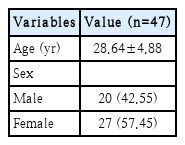
Demographic and audiometric characteristics of study participants

Preferred listening levels
To quantify the level of noise suppression when using ANC, we measured the PLLs. This psychoacoustic measure indicates the volume level at which each participant perceived the most comfortable volume without further adjustments. Dynamic range and volume adjustment were requested by each participant while listening to a song (“Dynamite” by BTS) via wireless earbuds they were wearing. While they were listening to the song, bus and café noises from YouTube were provided from four surrounding speakers as background noises. Fig. 1 presents the time-domain waveforms and Fast Fourier Transform of the noise signals plotted using Python. The waveform of the bus noise showed greater fluctuations compared to the café noise, and its frequency spectrum indicated dominant low-frequency energy. In contrast, the café noise showed relatively higher energy in the mid-frequency range. This everyday noise was adjusted such that its LAeq was 80 dB SPL, as measured using a sound-level meter (2250 Light, Brüel & Kjaer) and presented from loudspeakers located at 45°, 135°, 225°, and 315° relative to the participant.
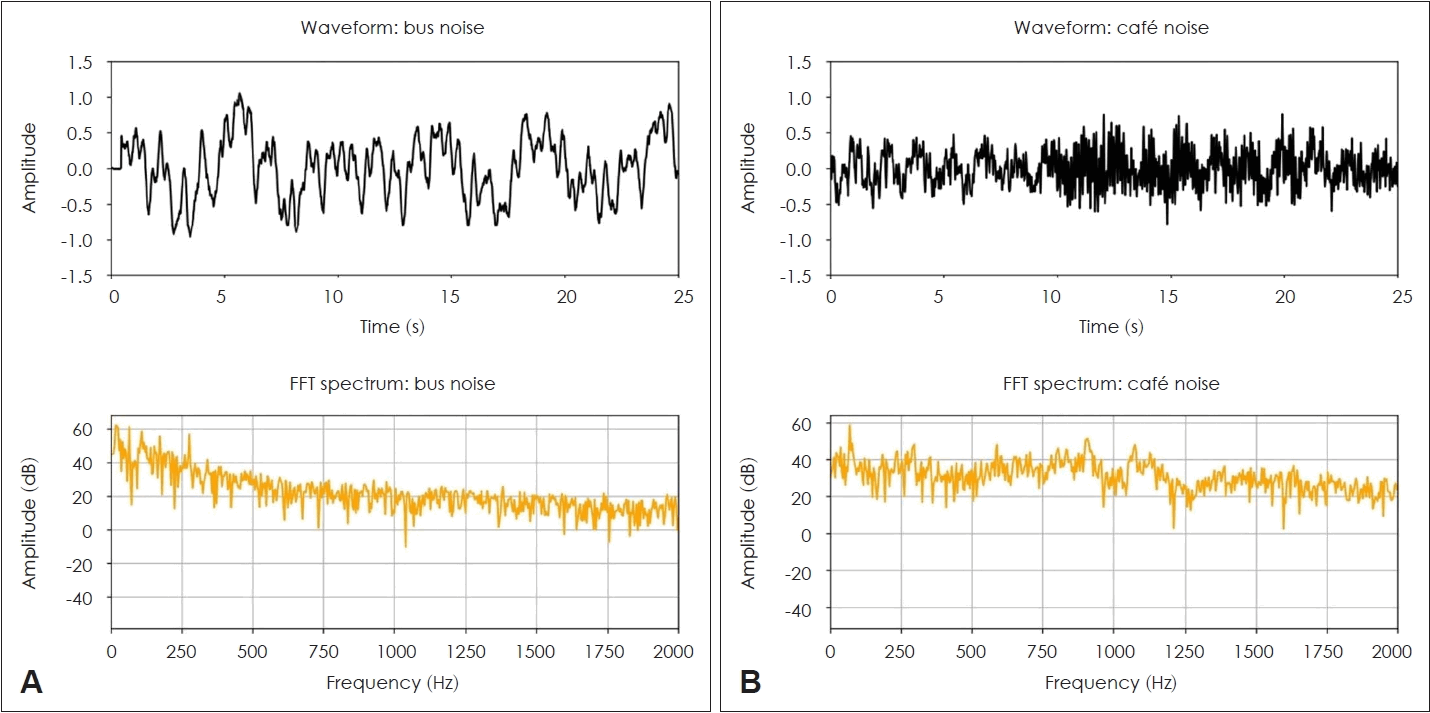
Time-domain waveforms and FFT spectra of noise signals: bus (A) and café (B). FFT, Fast Fourier Transform.
After listening to the song in the presence of environmental noises for a few minutes, the participants were asked to adjust the volume level to determine the most comfortable level among 15 volume control steps available on a smartphone (Samsung Galaxy S9, Samsung Electronics) when the ANC function was turned on (referred to as ANC ON) or off (referred to as ANC OFF), respectively. We instructed each participant as follows: “Please start with the smartphone’s volume at zero and adjust it to the most comfortable level for you to enjoy the song you are listening to through the earbuds.” We tested PLLs with ANC ON and ANC OFF separately using four different earbud types while all conditions remained the same to ensure consistency. For PLL testing, the order of earbud types and ANC conditions (ANC OFF and ANC ON) was randomized across participants to minimize potential order effects. These four earbuds were commercially available devices released on the market after 2019 and referred to as A, B, C, and D throughout this study. The earbuds were manufactured by two internationally well-known electronics companies, with sets A and B from one company and sets C and D from the other. A and C were the newest generation of wireless earbuds, whereas B and D were the previous generation versions of the A and C devices, respectively. The available key technical specifications of the four earbuds, including form factor, driver configuration, microphone arrangement, ANC processor generation, ANC type, and Bluetooth version, are summarized in Supplementary Table 1. For the experiment, REM was performed directly to measure the increase in sound pressure level (SPL) in dB (dB SPL) as the volume increased. The measured dB SPL for each volume step is presented in Table 2; step increments were larger at lower volumes and smaller at higher volumes.
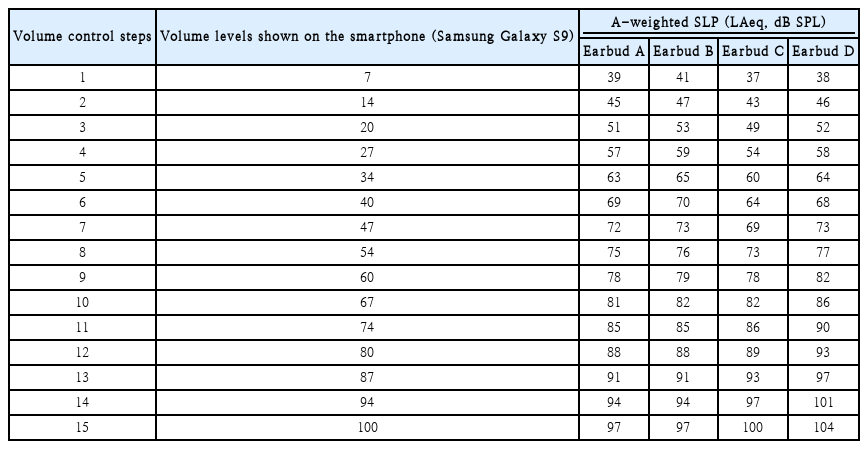
A-weighted equivalent continuous SLPs (LAeq, dB SPL) corresponding to the 15 volume steps on the smartphone
The PLLs measured when the ANC function was off (ANC OFF) vs. on (ANC ON) were compared to quantify the effect of ANC on background noise reduction and enhancing SNR. The 15 volume control steps (scaled from 1 to 100) on the smartphone were measured in LAeq (in dB SPL) using a sound-level meter (2250 Light, Brüel & Kjaer) with a 2-cc coupler compliant with the IEC 60318-5 standard and are presented in Table 2. All measurements were conducted in an anechoic chamber.
Real ear measurement
REM is an objective method that accurately assesses the level of sound amplification of a hearing aid sitting in the ear canal and is considered the gold standard for verifying hearing aids in audiology. We applied the REM (Affinity 2.0, Interacoustics) to measure the SPL of the signal provided by each set of earbuds (A, B, C, and D). After calibration, a probe tube was labeled 30 mm from its tip and inserted into the ear canal of the right ear of each subject. The in-ear SPLs were measured under both ANC OFF and ANC ON conditions with background noise (bus noise) emitted from four surrounding speakers. For REM testing, the order of earbud types and ANC conditions was also randomized across participants. The dB SPLs measured in the ANC OFF and ANC ON conditions were then compared to quantify the effect of ANC on noise reduction.
Statistical analysis
Statistical analyses were performed using R 4.1.3 (R Foundation for Statistical Computing). Two-way RM ANOVA was conducted to compare PLL and REM results across ANC con-ditions (ANC OFF and ANC ON) and earbud type (A, B, C, and D). Post-hoc analysis was conducted to compare the effect of ANC across earbuds, and all reported p values for pairwise comparisons were adjusted using Tukey adjustment for multiple comparisons. Statistical significance was defined as a twosided p<0.05.
Results
Preferred listening levels
PLL results are shown in Table 3 and Fig. 2. Descriptive statistics, including mean values, standard deviations, withinparticipant mean differences between ANC OFF and ANC ON (ΔdB SPL), and 95% confidence intervals for the mean differences, as well as effect size measures, are presented in Table 3. Volume levels on the smartphone were converted to corresponding dB SPL values (Table 2) for data analysis. Two-way RM ANOVA results showed that PLLs had significant interaction between earbud type and ANC status in both bus noise (F(3, 138)=7.03, p<0.001) and café noise (F(3, 138)=5.02, p=0.003) conditions. We also found a significant main effect of ANC (F(1, 46)=282.90, p<0.001 with bus noise; F(1, 46)=270.47, p<0.001 with café noise) and earbud type (F(3, 138)=43.60, p<0.001 with bus noise; F(3, 138)=32.83, p<0.001 with café noise). Post hoc analysis was performed to compare the ANC function across the four different earbuds. The difference in PLLs measured in the ANC OFF and ANC ON (ΔdB SPL in Table 3) was calculated and then compared. Earbud C demonstrated the greatest reduction in PLLs at ANC ON (average 7.58 ΔdB SPL with bus noise, 6.52 ΔdB SPL with café noise). Post-hoc analysis revealed that earbud C had a significantly greater reduction than earbuds A and B under bus noise (p=0.004 and p<0.001, respectively) and than earbud B under café noise (p=0.002). The other earbuds did not differ significantly from one another.
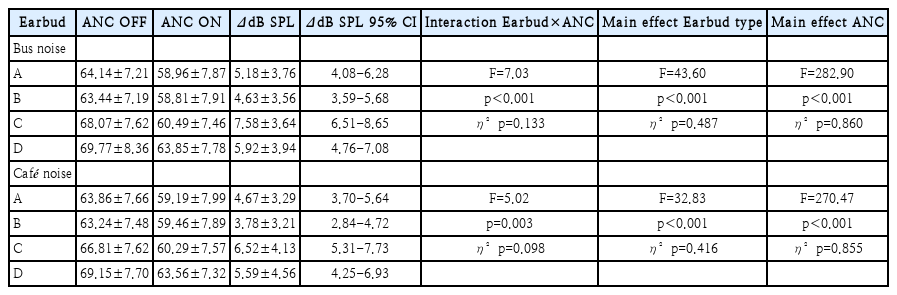
Comparison of PLLs (LAeq, dB SPL) between ANC OFF and ANC ON across four earbuds
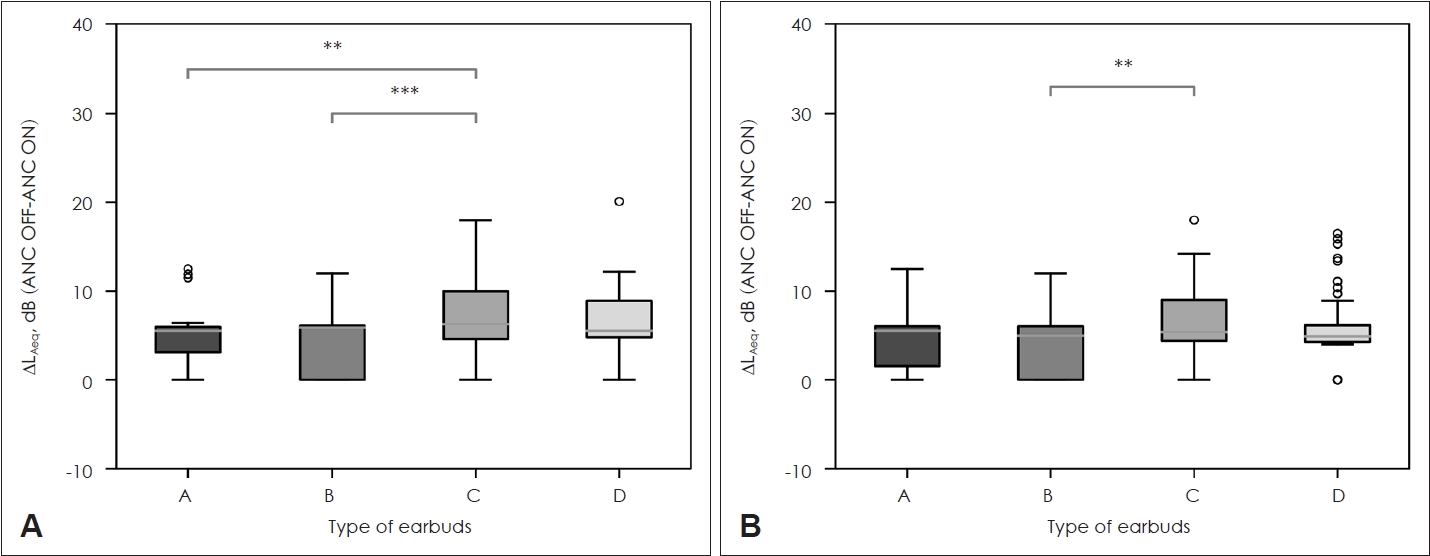
Comparison of ΔdB SPL across four earbud types under bus (A) and café (B) noise conditions. **p<0.01; ***p<0.001. LAeq, Aweighted equivalent continuous sound pressure level; dB SPL, sound pressure level in decibels.
Real ear measurement
We analyzed the sound reduction in dB SPL measured by REM at low frequencies (125-500 Hz), high frequencies (3000-6000 Hz), and whole frequencies (125-6000 Hz) separately. ANC best controls low-frequency noises (100-500 Hz) [21]. A comparison of changes in dB SPL values between ANC OFF and ANC ON at low and high frequencies may provide complementary information to characterize the effect of ANC on noise suppression. Table 4 and Fig. 3 present comparisons of changes in dB SPL between ANC OFF and ANC ON. Descriptive statistics, including mean values, standard deviations, within-participant mean differences between ANC OFF and ANC ON (ΔdB SPL), and 95% confidence intervals for the mean differences, as well as effect size measures, are presented in Table 4. SPLs were generally lower in the ANC ON condition, particularly at low frequencies. The interaction between earbud type and ANC status was significant at low frequencies (F(3, 138)=21.42, p<0.001), high frequencies (F(3, 138)=9.26, p<0.001), and whole frequencies (F(3, 138)=20.64, p<0.001). Also, there was a significant main effect of ANC status (F(1, 46)=1705.66, p<0.001 at low frequencies; F(1, 46)=24.36, p<0.001 at high frequencies; F(1, 46)=954.58, p<0.001 at whole frequencies) and earbud type. As expected, the amount of sound reduction between ANC OFF and ANC ON (ΔdB SPL) was larger at low frequencies (approximately 20-28 dB SPL) compared to those at high frequencies (approximately -1 to 3 dB SPL) and whole frequencies (approximately 9-14 dB SPL), as shown in Table 4. Earbud C had the greatest mean reduction at low frequencies (28.87 dB) and across the whole frequency range (14.88 dB), whereas earbud D had the greatest mean reduction at high frequencies (3.41 dB). At low frequencies, earbud C showed significantly greater attenuation than earbuds A, B, and D (all Tukey-adjusted p<0.001), and earbud D showed greater attenuation than earbud A (p=0.005). At high frequencies, earbuds A, C, and D showed greater attenuation than earbud B (all p<0.001); the differences among earbuds A, C, and D were not significant. Across the whole frequency range, earbud C showed greater attenuation than earbuds A and B (both p<0.001), and earbud D showed greater attenuation than earbuds A and B (p=0.007 and p<0.001, respectively). The difference between earbuds C and D was not significant (p=0.282). No other pairwise comparisons were significant.
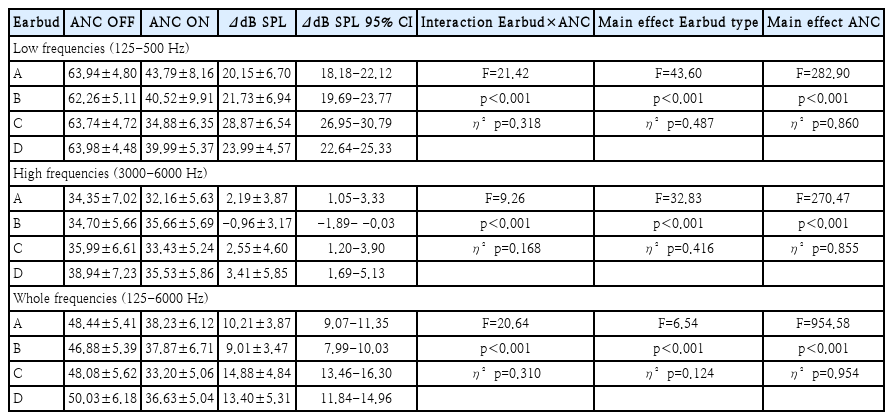
Comparison of REM-measured dB SPL between ANC OFF and ANC ON across earbuds and frequency ranges
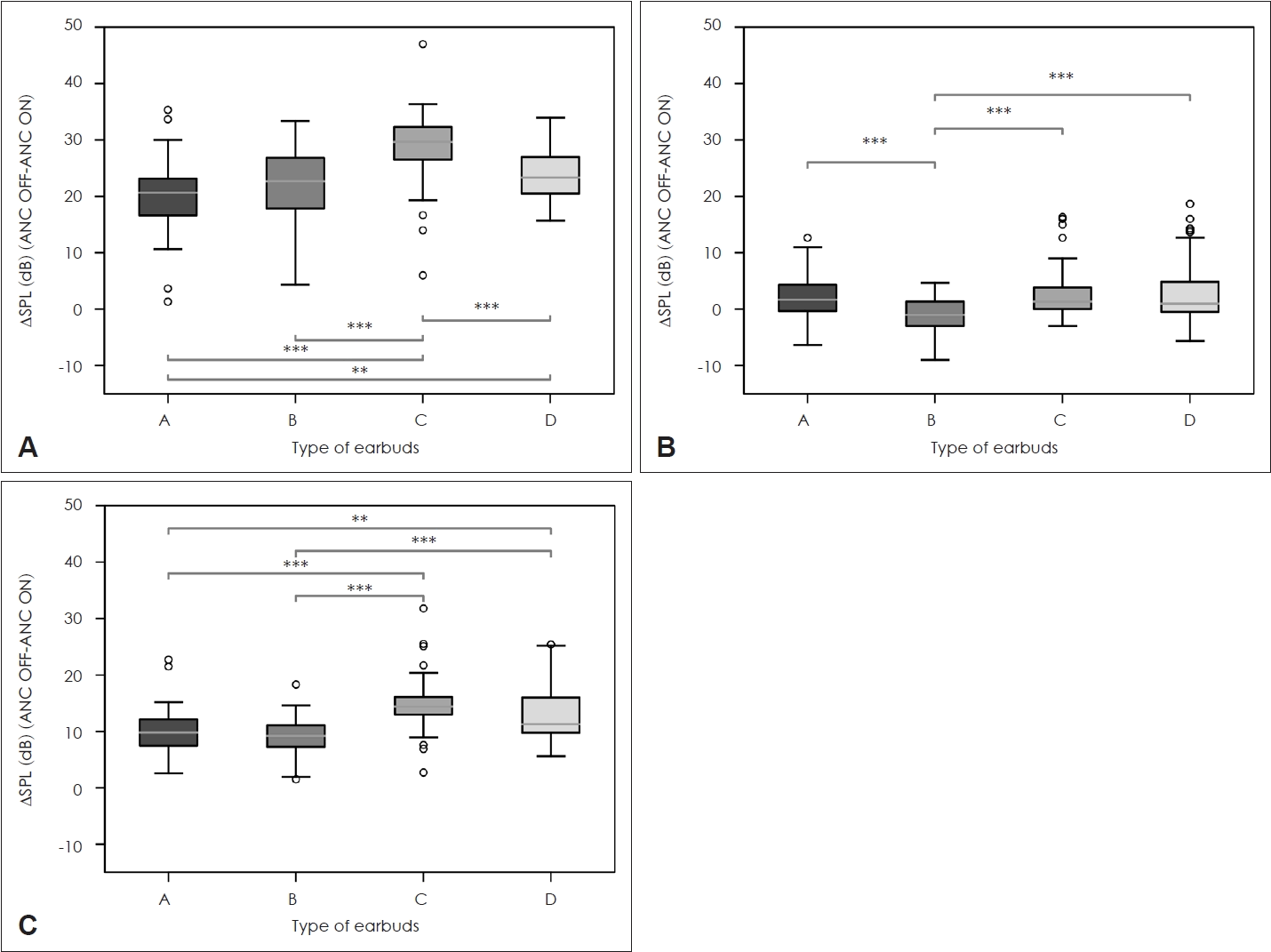
Comparison of ΔdB SPL across the four earbud types at low (A), high (B), and whole (C) frequencies. **p<0.01; ***p<0.001. dB SPL, sound pressure level in decibels.
Discussion
This study investigated the effect of ANC on noise reduction in four commercially available earbuds featuring the lat-est ANC technology. Results showed significant interaction effects for both ANC status and earbud type in PLLs and REM measurements. This suggests that the effectiveness of ANC varies depending on earbud type, which may reflect the variability in ANC across commercially available earbuds. A previous study that compared ANC features in wireless canal-type earphones to those in wired canal-type earphones reported an average reduction of 6 to 12 volume levels in PLLs, a decrease of 15.5 dB SPL across the low-frequency range, and a decrease of 7.7 dB SPL across the whole frequency range [17]. Another study compared ear-canal earphones to on-the-ear earphones and covering-the-ear earphones and found an average reduction of 2.7 dB SPL in PLL and 3.1 dB SPL in REM across the three types of earphones [19]. Similarly, Hoshina, et al. [20] evaluated the effects of ANC in various earphone and headphone types, finding that canal-type earphones equipped with ANC reduced PLLs to safer levels below 75 dB SPL (A-weighted) even in noisy environments, highlighting the important role of ANC in reducing hearing risk. Our results were consistent with the findings of previous studies, while the latest ANC technology showed slightly better noise suppression compared to the previous generation ANC technology.
Moreover, this study showed a significant main effect of ANC and earbud type on both PLL and REM tests, with both measures (dB SPL) being lower when ANC was on. Post hoc analyses showed differences between the four earbuds. In the PLL test, earbud C showed the most significant differences compared to other earbuds. In the REM test, earbud C showed the largest mean reductions at low frequencies and across the whole frequency range, whereas earbud D showed the largest mean reduction at high frequencies.
When we tested the four commercially available wireless earbuds equipped with ANC technology, all tested earbuds were effective in suppressing noise levels both subjectively (PLLs) and objectively (REM values), as both PLL and REM results (dB SPL) were significantly lower when ANC was on (Tables 3 and 4). All tested earbuds consistently showed a considerable reduction in sound level at low frequencies when ANC was on. Low-frequency noise, such as traffic noises and amplified background music, is pervasive in daily life and is often recognized as “unwanted sound” that deteriorates SNR. Since this noise tends to propagate over longer distances, it can be difficult to avoid [22]. These results indicate that ANC technology may help reduce potential sound exposure by attenuating low-frequency environmental noise and allowing users to select lower PLLs in noisy environments.
Post-hoc analyses showed different results across the four earbuds, suggesting variability in ANC performance among commercially available wireless earbuds. In PLL testing, earbud C showed the most consistent significant post-hoc differences compared with the other earbuds. In REM testing, earbud C showed the greatest reduction at low and whole frequency ranges, whereas earbud D showed the largest reduction at high frequencies. As summarized in Supplementary Table 1, the tested models differed in several publicly available technical specifications, including driver configuration, microphone arrangement, ANC processor generation, ANC type, and Bluetooth version. These differences may partly explain the observed between-model variability in PLL and REM outcomes. However, because detailed proprietary information regarding internal acoustic design, chipset architecture, and ANC algorithms was not publicly disclosed by the manufacturers, the exact technical mechanisms underlying the differences in ANC performance could not be fully determined.
Despite these advantages in terms of noise reduction, ANC function has several limitations. First, as shown in our REM results, it is challenging to block high-frequency noise effectively. High-frequency sounds have shorter wavelengths and faster oscillations, which can make it challenging to generate an opposing wave in time for effective noise cancellation. On the other hand, low-frequency sounds oscillate more slowly, providing sufficient time to generate an effective opposing wave for noise cancellation [23]. The significant noise reduction at high frequencies observed with earbud D suggests that mitigating high-frequency noise may be an important factor in improving listening performance in everyday noisy environments. However, safety concerns exist. For instance, important emergency signals are at high frequency and could be missed, as could roadway or vehicle noise that may potentially lead to unwanted traffic accidents [24,25]. Despite these drawbacks, ANC may be a useful tool for reducing perceived background noise and supporting more comfortable listening in challenging noisy conditions.
This study has several limitations. First, the effectiveness of ANC in PLDs may be influenced by individual variation in ear shape, earbud fit, ear tip size, and earbud design. Although these factors reflect important aspects of real-world use, they were not systematically manipulated in the present study. Second, the study included 47 young adults with normal hearing. This restricts the representativeness of the sample and limits the generalizability of the findings to broader populations, particularly adolescents, older adults, and individuals with hearing loss, who may have different listening behaviors, noise exposure patterns, auditory sensitivity, and susceptibility to noise-related risks. Third, the experiments were conducted under controlled, laboratory-based conditions using selected environmental noises and standardized listening procedures. Specifically, the listening tasks used one bus noise recording, one café noise recording, and a single music track, and the REM measurements were conducted in an anechoic chamber. Although this approach allowed systematic comparison across earbud types and ANC conditions, it may not fully reflect the complexity and variability of real-world listening environments, where background noise, user movement, earbud fit, music content, and listening behavior can vary substantially. Therefore, the present findings should be generalized to everyday listening situations with appropriate caution. Fourth, the analysis was limited to PLD devices manufactured by two companies, which may restrict the generalizability of the findings to other commercially available devices. In addition, proprietary ANC algorithms and detailed internal acoustic designs were not disclosed by the manufacturers, making it difficult to fully characterize the technical mechanisms underlying the between-model differences in ANC performance observed in this study. Lastly, our LAeq measurements were not normalized to an 8-hour exposure duration (LEX, 8 h). Therefore, direct comparison with regulatory hearing damage risk thresholds was not possible, and caution should be taken when interpreting the noise exposure results in the context of long-term hearing safety. The majority of participants were female, which may also reflect participation bias. Although sex was not a primary variable of interest, this imbalance may affect the generalizability of the results and should be considered.
In conclusion, ANC-equipped wireless earbuds reduced PLLs and real-ear sound levels in noisy environments, particularly by attenuating low-frequency background noise. These findings suggest that ANC may help reduce potential sound exposure during PLD use. However, because this study did not assess longitudinal audiometric outcomes or the incidence of NIHL, the results should not be interpreted as direct evidence that ANC prevents NIHL. Further studies are needed to evaluate the long-term implications of ANC use for hearing health.
Supplementary Materials
The Supplement is available with this article at https://doi.org/10.3342/kjorl-hns.2026.00367.
Notes
Acknowledgments
This work was supported by an internal grant from the Hearing Research Laboratory at the Samsung Medical Center (grant no: PHO0240751).
Author Contribution
Conceptualization: Hee Jung Yun, Jeong-Seo Kim, Mini Jo, Il Joon Moon. Methodology: Hee Jung Yun, Jeong-Seo Kim, Mini Jo. Formal analysis: Hee Jung Yun, Seoyoung Jo, Mini Jo, Doyun Kim, Sujin Lee. Investigation: Hee Jung Yun, Seoyoung Jo, Mini Jo, Doyun Kim, Sujin Lee. Writing—original draft: Hee Jung Yun, Seoyoung Jo, Jeong-Seo Kim. Writing—review & editing: Hee Jung Yun, Seoyoung Jo, Jeong-Seo Kim, Il Joon Moon.