Comparison of Early and Late Dropout Factors in Positive Airway Pressure Therapy for Obstructive Sleep Apnea
폐쇄성 수면무호흡증 양압기 치료에서 조기 및 후기 탈락 요인의 비교
Article information

Abstract
Background and Objectives
Positive airway pressure (PAP) therapy is the gold-standard treatment for obstructive sleep apnea (OSA), yet a substantial proportion of patients discontinue treatment, with underlying causes potentially differing by dropout timing. This study aimed to compare clinical characteristics, polysomnography (PSG) findings, and reasons between early dropouts (ED; ≤3 months) and late dropouts (LD; >3 months), and to identify factors associated with dropout timing.
Subjects and Method
This retrospective study included 106 OSA patients who discontinued PAP therapy (ED, n=62; LD, n=44), classified by the Korean National Health Insurance 3-month adherence evaluation cutoff. Dropout causes were extracted from structured nursing records and categorized into four mechanistic domains.
Results
Baseline demographics and PSG parameters were compared between groups. Device discomfort (52.5% vs. 14.0%, p<0.001) and expiratory pressure resistance (22.6% vs. 0%, p<0.001) predominated in ED, whereas lack of perceived treatment effect (8.2% vs. 44.2%, p<0.001) and lack of disease awareness (1.6% vs. 15.9%, p=0.008) characterized LD. The Firth’s penalized logistic regression indicated that device discomfort was independently associated with ED (penalized odds ratio=3.65, 95% confidence interval: 1.34-9.99, p=0.012).
Conclusion
PAP dropout mechanisms differ qualitatively by timing. ED is driven by device-related physiological barriers, suggesting that early-phase management should prioritize device adaptation and pressure optimization, while long-term retention requires disease awareness reinforcement and objective efficacy feedback.
Introduction
Obstructive sleep apnea (OSA) is a highly prevalent chronic disorder characterized by repetitive upper airway collapse during sleep, associated with systemic hypertension, coronary artery disease, stroke, type 2 diabetes mellitus, depression, and cognitive impairment, imposing a substantial societal and economic burden [1,2].
Positive airway pressure (PAP) therapy remains the firstline treatment for moderate-to-severe OSA and for symptomatic mild OSA [3]. The clinical benefits of adequate PAP use are well-established, encompassing improvements in daytime sleepiness, blood pressure control, cardiovascular risk reduction, and health-related quality of life [4,5]. Nevertheless, suboptimal adherence constitutes the central clinical challenge of PAP therapy. Studies consistently report that only 30%-60% of patients meet the standard adherence threshold of ≥4 hours of nightly use, and a meaningful proportion discontinue therapy altogether within the first year of treatment [6].
Previous research has identified a range of factors associated with PAP non-adherence, including mask discomfort and air leakage, pressure intolerance, nocturnal mask dislodgement, oral dryness, claustrophobia, lack of perceived therapeutic benefit, low self-efficacy, insufficient patient education, and inadequate social support [7-9]. However, the majority of prior studies have conceptualized dropout as a single, homogeneous event and have not distinguished between patients who discontinue therapy early in the treatment course and those who abandon it after a period of successful use. In the Republic of Korea, the National Health Insurance (NHI) system mandates a structured 90-day adherence evaluation period for PAP therapy reimbursement, requiring patients to achieve ≥21 nights of ≥4 hours of nightly use within any consecutive 30-day window during the first 3 months. To the best of our knowledge, no studies to date have comparatively analyzed dropouts occurring during versus after the adherence evaluation period.
The present study therefore aimed to: 1) compare baseline clinical characteristics and polysomnography (PSG) findings between early dropout (ED) and late dropout (LD) patients; 2) compare patient-reported dropout causes both as individual items and within a four-domain categorical framework; and 3) identify factors associated with dropout timing using multivariable logistic regression. We hypothesized that dropout mechanisms would be qualitatively heterogeneous between the two groups, reflecting distinct pathophysiological and psychological processes that warrant targeted, time-differentiated intervention strategies.
Subjects and Methods
Study design and participants
This was a retrospective, single-center observational study. The study was approved by the Institutional Review Board (IRB No. EMC 2026-04-017) and was conducted in accordance with the Declaration of Helsinki. We retrospectively reviewed the medical records and PSG data of consecutive adult patients who underwent attended overnight sleep studies at our sleep center for evaluation of sleep-disordered breathing between July 2021 and March 2026. Of 301 patients diagnosed with OSA who subsequently initiated PAP therapy, 197 (65.4%) were ongoing PAP users at the time of data collection, and 106 (35.2%) had discontinued treatment. These 106 dropout patients constituted the final study cohort.
Inclusion criteria were: 1) age ≥18 years; 2) diagnosis of OSA defined as apnea-hypopnea index (AHI) ≥5 events/h on attended overnight PSG; and 3) initiation of PAP therapy following prescription at our institution. Exclusion criteria were: 1) poor-quality PSG recordings or absence of key variables required for analysis and 2) insufficient clinical follow-up precluding reliable determination of dropout timing or cause.
Group classification
Patients who discontinued PAP therapy were classified into two mutually exclusive groups based on the timing of treatment discontinuation. ED was defined as cessation of PAP use within 3 months of prescription initiation (n=62). LD was defined as cessation occurring more than 3 months after initiation (n=44). This cutoff was selected to align with the Korean NHI mandatory PAP adherence evaluation period. Patients classified as ED therefore failed to complete or pass this initial adherence period, while LD patients had successfully passed the evaluation but subsequently withdrew from treatment. The complete study flow is shown in Fig. 1.
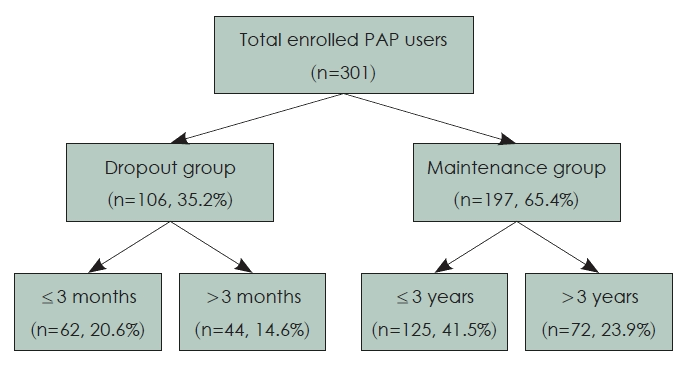
Flowchart of patient enrollment and group classification. Of 301 patients who initiated PAP therapy, 106 discontinued treatment and were classified as ED (≤3 months, n=62) or LD (>3 months, n=44). ED, early dropout; LD, late dropout; PAP, positive airway pressure.
Polysomnography
Nocturnal PSG was performed using the Embla N7000 system (Natus) and was supervised by a trained technician. Monitored parameters included electroencephalography (EEG; F3, F4, C3, C4, O1, O2), electrooculography, chin and leg electromyography, electrocardiography, respiratory effort, nasal and oral airflow, and pulse oximetry. All recordings were scored by a board-certified specialist according to the American Academy of Sleep Medicine (AASM) guidelines. Apnea was defined as a ≥90% reduction in airflow for ≥10 s. Hypopnea was defined as a ≥30% reduction in nasal airflow for ≥10 s, associated with either an EEG arousal or ≥3% oxygen desaturation.
Low arousal threshold classification
The low arousal threshold (Low ArT) phenotype was determined using the criteria proposed by Edwards, et al.10) Patients meeting ≥2 of the following three criteria were classified as Low ArT: 1) AHI <30 events/h; 2) nadir SpO2 >82.5%; and 3) fraction of hypopnea (hypopnea index/total AHI) >58.3%.
Dropout cause classification
The primary reason for PAP discontinuation was systematically extracted from structured nursing progress notes, which comprised records of telephone follow-up interviews and outpatient consultation notes conducted by a dedicated PAP nurse coordinator. Multiple reasons were permitted per patient.
Dropout causes were classified into four mechanistic domains conceptually grounded in the multidimensional PAP adherence model proposed by Sawyer, et al. [7]. We acknowledge that the framework was developed for this study without formal inter-rater reliability assessment or expert panel consensus; its reproducibility in other clinical settings has not been established.
Dropout causes were analyzed at two levels. First, eight patient-reported categories were compared directly between groups. Second, causes were reclassified into four mechanistic domains: Category 1–physical and device-related factors (mask discomfort/air leak, oral dryness/nasal congestion, aerophagia); Category 2–physiological and therapeutic factors (expiratory pressure resistance, unconscious nocturnal mask removal, comorbid insomnia and sleep apnea [COMISA]); Category 3–psychological and behavioral factors (claustrophobia, lack of disease awareness, treatment burden/hassle); Category 4–environmental and administrative factors (failure to meet NHI compliance criteria, overseas travel, frequent business trips, inability to attend follow-up). Domain subtotals were computed as the proportion of patients with ≥1 item endorsed within each domain.
Statistical analysis
Between-group comparisons of continuous variables were performed using the independent samples t-test for normally distributed data and the Mann–Whitney U test for non-normally distributed data. Categorical variables were compared using the Pearson chi-square test or Fisher’s exact test, as appropriate. Statistical significance was defined as p<0.05. Multivariable binary logistic regression was performed with LD as the dependent variable (LD=1, ED=0). As a sensitivity analysis, Firth’s penalized likelihood logistic regression was applied to correct for small-sample bias.
Missing data: Insomnia Severity Index (ISI) data were missing in 50.0% of ED patients (31/62) and 50.0% of LD patients (22/44), attributable to sequential protocol changes rather than differential non-response (p=0.612 by chi-square). ISI was therefore excluded from multivariable analyses.
All statistical analyses were performed using SPSS 22.0 (IBM Corp.).
Results
Baseline clinical characteristics
A total of 106 patients who discontinued PAP therapy were included: 62 in the ED group and 44 in the LD group. The two groups were broadly comparable in baseline clinical characteristics (Table 1). Mean age was 53.3±14.4 years in ED vs. 48.1±14.0 years in LD (p=0.069), with a numerical but nonsignificant trend toward older age in the ED group. Daytime sleepiness (Epworth Sleepiness Scale: 9.3±4.2 vs. 8.1±5.4, p=0.099), sleep quality (Pittsburgh Sleep Quality Index: 12.2±6.1 vs. 11.1±5.9, p=0.264), and insomnia severity (ISI: 9.7±7.0 vs. 8.4±6.0, p=0.465) were similar between groups. OSA severity distribution was nearly identical between groups (p=0.988), with approximately 50% of each group classified as severe (AHI ≥30/h). PAP device type was predominantly auto-titrating PAP (APAP) in both groups (98.4% vs. 93.2%, p=0.305), with no significant difference in overall device distribution (p=0.322).
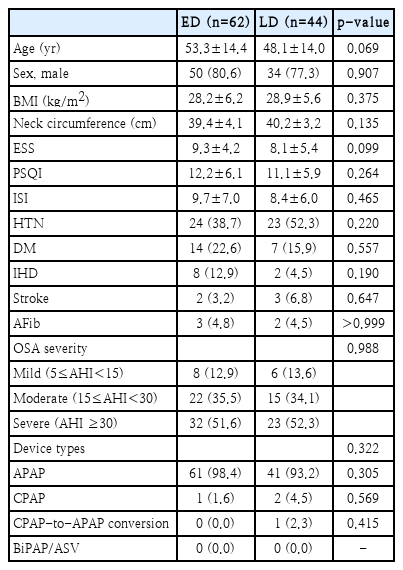
Baseline clinical characteristics of ED and LD groups
Polysomnographic findings
All PSG parameters were comparable between ED and LD groups, with no statistically significant differences observed (Table 2). Sleep architecture was similar between groups, including sleep efficiency (84.1%±10.4% vs. 84.0%±10.5%, p=0.971), N3 percentage (22.6%±12.7% vs. 25.6%±14.5%, p=0.185), and rapid eye movement percentage (16.8%±10.9% vs. 17.1%±7.5%, p=0.792).
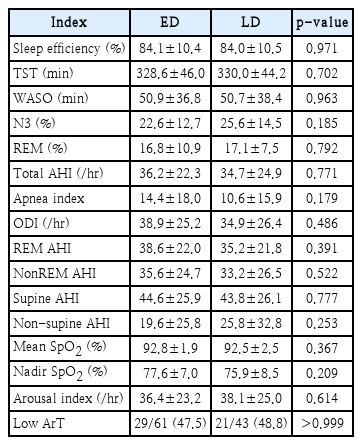
Comparison of polysomnography parameters between ED and LD groups
Respiratory parameters, including total AHI (36.2±22.3/h vs. 34.7±24.9/h, p=0.771), nadir SpO2 (77.6%±7.0% vs. 75.9% ±8.5%, p=0.209), and arousal index (36.4±23.2 vs. 38.1± 25.0/h, p=0.614) were all statistically indistinguishable between groups. The Low ArT phenotype, classified according to Edwards criteria, was present in 47.5% (29/61) of ED patients and 48.8% (21/43) of LD patients (p>0.999).
Patient-reported dropout causes
Significant between-group differences were observed in several patient-reported dropout causes (Table 3). Device discomfort—encompassing mask leakage, pressure intolerance, and related physical complaints—was reported by 52.5% of ED patients versus 14.0% of LD patients (p<0.001). Nocturnal mask removal during sleep was also more frequent in ED (26.2% vs. 9.3%, p=0.038). Conversely, lack of perceived treatment effect was substantially more prevalent in LD (44.2% vs. 8.2%, p<0.001). Lack of motivation or laziness showed a borderline difference (13.1% vs. 27.9%, p=0.058). Other causes—including external factors, health/medical reasons, work-related time constraints, and discontinuation following weight loss—did not differ significantly between groups.
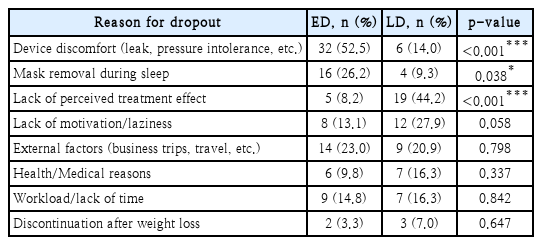
Patient-reported reasons for PAP discontinuation between ED and LD dropout groups
Four-domain categorical analysis of dropout causes
Domain-level analysis revealed distinct mechanistic profiles for ED and LD (Table 4). Category 2 (physiological and therapeutic factors) was significantly more prevalent in ED than LD (29.0% vs. 6.8%, p=0.006). This difference was driven predominantly by expiratory pressure resistance discomfort (Item 2a), which was reported by 22.6% of ED patients (14/62) and by none of the LD patients (0/44; p<0.001). This pattern of complete separation indicates that expiratory pressure resistance is a near-exclusive predictor of early rather than LD. COMISA (Item 2c) was observed at comparable rates in both groups (6.5% vs. 6.8%, p>0.999).
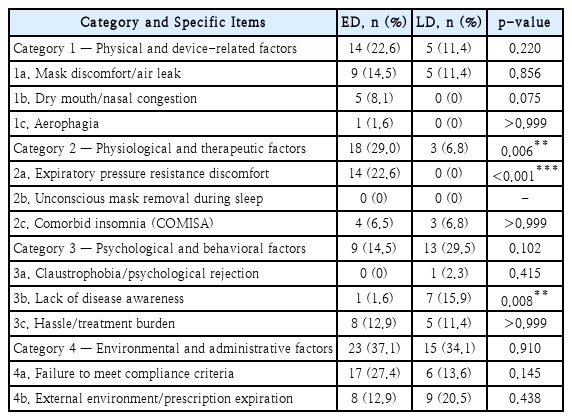
Frequencies of PAP dropout causes categorized by four mechanistic domains
Category 1 (physical and device-related factors) subtotal was numerically higher in ED (22.6% vs. 11.4%, p=0.220) but did not reach statistical significance. Notably, item-level mask discomfort/air leak (Item 1a) was also non-significant (14.5% vs. 11.4%, p=0.856), indicating that pure mask-related physical discomfort, when isolated from expiratory pressure resistance, does not distinguish between the two groups.
Category 3 (psychological and behavioral factors) subtotal showed a non-significant trend toward higher prevalence in LD (29.5% vs. 14.5%, p=0.102). Within this category, lack of disease awareness (Item 3b) was significantly more common in LD (15.9% vs. 1.6%, p=0.008). This item represents patients who, after a period of PAP use, concluded that their condition was not serious enough or that the therapy was no longer necessary. Category 4 (environmental and administrative factors) was similarly distributed between groups (37.1% vs. 34.1%, p=0.910).
Multivariable logistic regression
In the multivariable model (age, hypertension, device discomfort, lack of disease awareness, and Low ArT; n=106), device discomfort was the sole factor independently associated with ED on Firth’s penalized logistic regression (penalized odds ratio [pOR]=3.65, 95% confidence interval [CI]: 1.34-9.99, p=0.012; Nagelkerke R²=0.239) (Fig. 2). Expiratory pressure resistance showed complete separation (ED: n=14, LD: n=0) and was therefore excluded from the multivariable model; univariable Firth’s regression yielded a pOR of 26.61 (95% CI: 1.40-506.70, p=0.029), consistent with its near-exclusive occurrence in ED. Lack of disease awareness showed a consistent trend toward LD (pOR=0.18, 95% CI: 0.02-1.31, p=0.090), but this association did not reach statistical significance and should be regarded as exploratory given the limited event count (n=8).
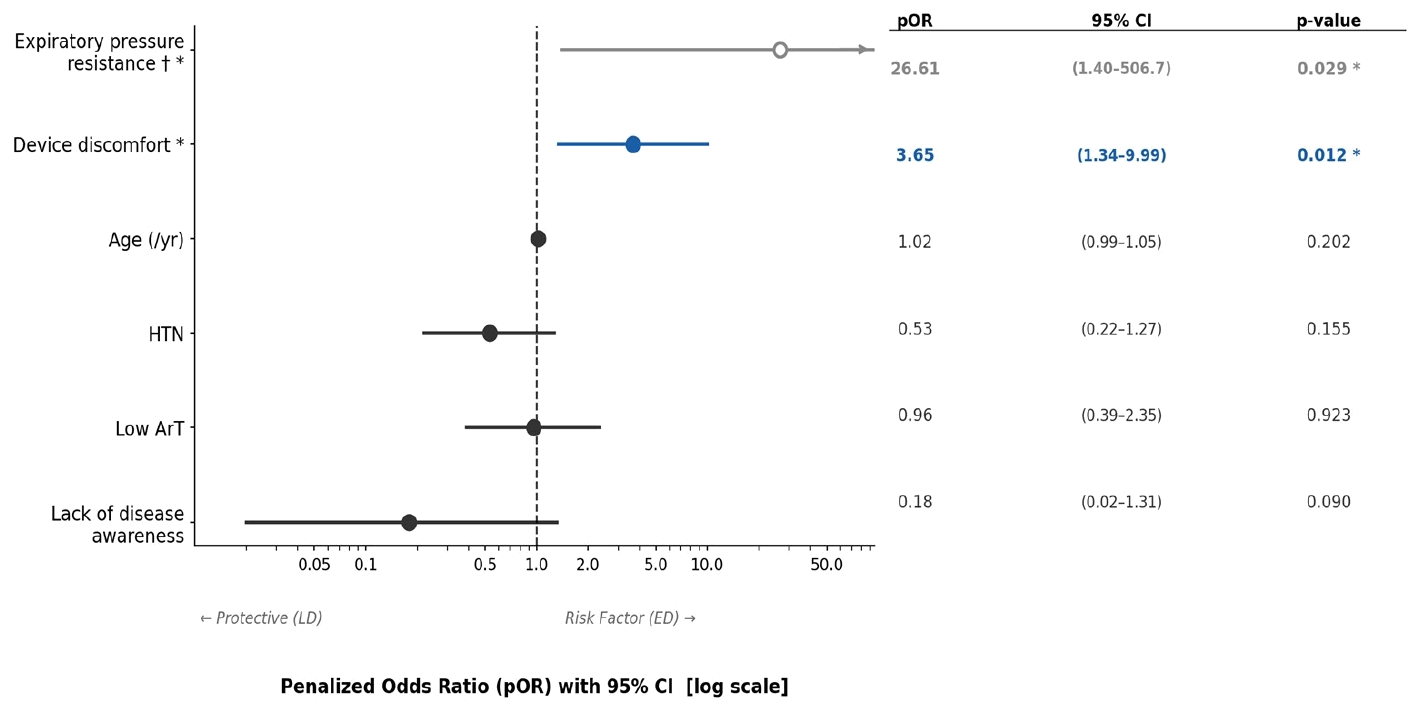
Forest plot of Firth’s penalized logistic regression analyses for factors associated with ED (ED=1 vs. LD=0; n=106; Nagelkerke R2=0.239). Outcome is coded as ED (ED=1), such that pOR >1 indicates a factor more prevalent in ED and pOR <1 indicates a factor more prevalent in LD. *p<0.05; †expiratory pressure resistance showed complete separation (ED: n=14, LD: n=0) and was excluded from the multivariable model; the pOR shown (26.61; 95% CI: 1.40–506.70) is derived from a separate Firth’s penalized univariable logistic regression and is presented for reference only. CI, confidence interval; ED, early dropout; HTN, hypertension; LD, late dropout; Low ArT, low arousal threshold; pOR, penalized odds ratio.
Discussion
To our knowledge, this is among the first studies to systematically compare PAP dropout mechanisms by treatment timing within the context of a structured national insurance adherence framework. Our principal finding is that early and late PAP dropout are mechanistically distinct phenomena. ED was characterized by device-related physiological barriers—most notably expiratory pressure resistance, which occurred exclusively in ED patients (22.6% vs. 0%, p<0.001), and device discomfort, the sole factor independently associated with ED on multivariable analysis (pOR=3.65, p=0.012). LD, by contrast, was characterized by cognitive and motivational factors, particularly lack of disease awareness, which was significantly more prevalent in LD (15.9% vs. 1.6%, p=0.008) and showed a consistent trend on sensitivity analysis (pOR=0.18, p=0.090), though this finding remains exploratory given the limited event count. These qualitatively different mechanisms carry distinct clinical implications and call for time-differentiated intervention strategies.
The key finding was the complete separation observed for expiratory pressure resistance: 22.6% of ED patients reported this symptom, compared with 0% among LD patients (p<0.001). This pattern of perfect early-group specificity suggests that expiratory pressure resistance functions as a near-dichotomous ED trigger rather than a graded risk factor distributed across both groups. PAP therapy requires patients to exhale against a continuous positive pressure, which many patients describe as breathlessness, suffocation, or inability to complete a natural breath cycle [11]. This sensation is most intense at treatment initiation and typically attenuates as patients physiologically adapt to PAP [12]. When adaptation does not occur—whether due to individual variability in expiratory tolerance, inappropriately high prescribed pressures, or the absence of timely clinical intervention—the patient abandons treatment before the habituation window closes.
Several evidence-based device strategies are available to address expiratory pressure resistance in clinical practice. The most widely adopted is expiratory pressure relief (EPR), available under various proprietary names (EPR, ResMed; C-Flex/A-Flex, Philips; SensAwake, Fisher & Paykel), which detects the onset of exhalation and transiently reduces delivered pressure by 1-3 cmH2O before restoring the therapeutic level during inspiration. The ramp function—which initiates therapy at a low pressure and gradually ascends to the therapeutic target over 20-45 minutes, or until sleep onset is detected in smart-ramp models—also reduces the perceived burden of initial high-pressure exposure. At the hardware level, masks with optimized exhalation port geometry facilitate CO2 clearance while reducing expiratory back-pressure, and wider-diameter tubing decreases overall circuit resistance. Notably, Chihara, et al. [13] reported that among patients with poor initial PAP adherence (<4 h/night), switching to APAP combined with C-Flex/A-Flex significantly improved compliance (p=0.01), suggesting that expiratory pressure relief may be particularly effective as a rescue strategy in patients specifically identified as pressure-intolerant. In a complementary large-scale real-world analysis, Benjafield, et al. [14] demonstrated that switching non-compliant patients from CPAP/APAP to bilevel PAP within the first 90 days of therapy resulted in meaningful improvements in daily device usage. These findings suggest that systematic screening for expiratory resistance during the adherence evaluation period—using a structured follow-up questionnaire that specifically asks whether patients experience breathlessness during exhalation—would identify a clinically actionable subgroup in whom EPR activation, pressure re-titration, or early device modification may meaningfully prevent ED, an approach that warrants prospective evaluation.
Importantly, pure mask-related physical discomfort (Item 1a: mask leakage and pressure on skin) was not significantly different between groups (14.5% vs. 11.4%, p=0.856), even though the umbrella patient-reported category of “device discomfort” was highly significant (52.5% vs. 14.0%, p<0.001). This apparent paradox resolves when recognizing that patients tend to express expiratory pressure resistance colloquially as “the device feels suffocating” or “I cannot breathe”—language that clinical staff may initially record as generalized device discomfort. The structured domain analysis in the present study, which disaggregated expiratory pressure resistance from physical mask-related complaints, revealed that it is the former that drives the between-group difference, not the latter. This finding has a direct practical implication: asking patients specifically whether they experience breathlessness during exhalation, rather than recording only generalized discomfort, will identify those at highest risk for ED and enable targeted pressure adjustment or device modification.
Although lack of disease awareness did not reach statistical significance on Firth’s penalized regression (pOR=0.18, p=0.090), its significantly higher prevalence in LD (15.9% vs. 1.6%, p=0.008) highlights a well-recognized but difficult-to-address challenge in chronic disease management. OSA is largely asymptomatic during wakefulness; its most dangerous consequences (cardiovascular events, neurocognitive decline) are probabilistic and long-latency, and subjective symptom improvement with PAP may be inconsistent or imperceptible to individual patients [15]. In this context, patients who have survived the initial adaptation barrier and used PAP for several months may subsequently re-evaluate its necessity, concluding that the benefits no longer justify the continued effort.
These observations align with the behavioral economics concept of temporal discounting, whereby the immediate inconvenience of nightly device use is increasingly weighted against perceived future health benefits that become less tangible over time [7]. Effective late-dropout prevention therefore requires not merely education at initiation but ongoing motivational reinforcement that provides patients with objective, personalized evidence of treatment benefit. Sharing downloadable PAP usage reports showing AHI reduction and cumulative hours of effective use—framed in terms of cardiovascular events prevented or cognitive function preserved—may concretely counteract the cognitive drift toward treatment abandonment [16,17].
The finding that all PSG parameters—including AHI, oxygen desaturation index, nadir SpO2, sleep architecture indices, arousal indices, and Low ArT phenotype—were statistically indistinguishable between ED and LD groups is a critical negative result with important conceptual implications. It establishes that the timing of dropout is not determined by the objective severity of OSA or by the physiological phenotype of the patient’s sleep-disordered breathing. Low ArT, a phenotype characterized by a low threshold for cortical arousal from respiratory events, has been proposed as a determinant of PAP tolerance because arousals from expiratory pressure resistance might be exacerbated in patients with already-low arousal thresholds [10]. However, Low ArT prevalence was virtually identical in ED and LD groups (47.5% vs. 48.8%, p=1.000). This suggests that the mechanisms underlying dropout timing operate independently of PSG-measurable physiological phenotype, reinforcing the central role of behavioral and experiential factors.
Several limitations of this study warrant consideration. First, its retrospective, single-center design limits generalizability, and selection bias cannot be excluded. Second, dropout causes were extracted from structured nursing notes without formal validation (absence of inter-rater reliability testing for the four-domain classification). While the nursing coordinator’s systematic documentation provides high clinical ecological validity, the absence of standardized tools may have introduced classification inconsistency and may have missed causes not spontaneously reported by patients. Third, the ISI missing data rate (attributable to sequential protocol changes) of approximately 50% in both groups precluded a definitive assessment of insomnia comorbidity as a dropout modifier. The potential role of insomnia comorbidity as a modifier of dropout timing therefore remains unresolved and warrants prospective assessment with mandatory ISI collection.
In summary, the present study demonstrates that PAP dropout is mechanistically heterogeneous by timing, with expiratory pressure resistance dominating early discontinuation and lack of disease awareness driving late abandonment. The complete absence of PSG-based physiological parameters underscores that the timing of dropout is shaped not by disease biology but by the quality of the patient’s treatment experience. These findings provide an empirical foundation for developing time-tailored PAP retention programs: intensive device optimization within the first three months, followed by sustained motivational support and objective efficacy feedback beyond three months.
Notes
Acknowledgments
The authors thank the dedicated nursing staff of the Sleep Clinic at Eulji University Medical Center for their meticulous documentation of patient follow-up records, which made this analysis possible.
Author Contribution
Data curation: Myoung Su Choi, Jong Kwan Kim. Formal analysis: Myoung Su Choi. Methodology: Jong Kwan Kim. Writing—original draft: Myoung Su Choi, Jong Kwan Kim. Writing—review & editing: Myoung Su Choi.