Clinical Characteristics and Risk Factors for Major Complications in Recurrent Respiratory Papillomatosis: A Single-Institution Retrospective Study
단일 기관 후향적 연구를 통해 본 재발성 호흡기 유두종증 주요 합병증의 임상적 특징 및 위험 인자
Article information

Abstract
Background and Objectives
Recurrent respiratory papillomatosis (RRP) is a rare HPVassociated disease characterized by recurrent papillomatous lesions within the airway.
Subjects and Method
We retrospectively analyzed 165 patients who were treated for RRP at a single tertiary institution between 2005 and 2021 and evaluated clinical characteristics, treatment outcomes, and risk factors for major complications.
Results
Juvenile-onset RRP (JO-RRP) accounted for 11.5% of the cases, demonstrating a significantly more aggressive clinical course than adult-onset RRP (AO-RRP). JO-RRP patients showed markedly higher rates of subglottic spread, tracheotomy, and laryngeal stenosis, while no cases achieved remission. CO2, PDL, and KTP lasers were used for surgical treatment, often combined with intralesional cidofovir injection and HPV vaccination. Our findings suggest that JO-RRP is associated with poor prognosis and aggressive airway involvement. Tracheotomy and repeated surgeries are highly likely to serve as indicators reflecting disease severity, a prolonged disease course, lower respiratory tract involvement, and airway obstruction.
Conclusion
These findings suggest that continuous surveillance for complications is essential in patients with a high disease burden.
Introduction
Recurrent respiratory papillomatosis (RRP) is a rare disease that occurs in both children and adults and can cause dysphonia and airway obstruction because it develops throughout the airway tract, including the larynx. Cases occurring before the age of 12 are commonly classified as juvenile-onset RRP (JO-RRP), whereas those occurring after the age of 12 are classified as adult-onset RRP (AO-RRP) [1]. Although some patients experience spontaneous remission, others suffer from high recurrence rates requiring repeated surgical interventions, resulting in complications and deterioration in quality of life.
The primary treatment for RRP is surgical removal, and various types of lasers and surgical instruments have been used. Although the CO2 laser has traditionally been the most commonly used modality, photoangiolytic lasers such as the 532-nm potassium titanyl phosphate (KTP) laser and the 585-nm pulsed dye laser (PDL) have recently gained popularity. Because photoangiolytic lasers are selectively absorbed by hemoglobin and induce selective photoangiolysis, they provide excellent hemostatic effects and preserve surrounding normal tissues when removing highly vascularized lesions such as papillomas [2-5]. In addition to surgical excision, intralesional injections of antiviral or antiangiogenic agents have also been used. Previous studies reported that intralesional cidofovir injection after surgical removal delayed recurrence and progression of RRP [6-8]. More recently, intralesional bevacizumab injection, which has antiangiogenic properties, has been reported to improve voice function and reduce disease recurrence although it is off-label (not FDA-approved) therapy [9].
At our institution, RRP has been treated using both CO2 lasers and photoangiolytic lasers, combined with adjunctive treatments including intralesional cidofovir injection and HPV vaccination. In this study, we analyzed patients diagnosed with and treated for RRP at a single tertiary institution to investigate the clinical characteristics, treatment outcomes, and risk factors associated with major complications during treatment.
Subjects and Methods
We retrospectively reviewed the medical records of patients diagnosed with and treated for RRP at our institution between 2005 and 2021. The Institutional Review Board of Yonsei University approved this study (IRB No. 3-2026-0330). Patients diagnosed with RRP who were followed for at least 12 months were included. Patients who did not meet these criteria and those who had previously received treatment for RRP at outside institutions were excluded.
Medical and surgical records of all included patients were reviewed. Variables analyzed included age at diagnosis, sex, date of first surgery, date of last surgery, and total number of surgeries performed. Surgical instruments used, biopsy results, lesion location, complications, tracheotomy status, and malignant transformation were also investigated. Although the follow-up interval varied depending on the patient’s condition, disease severity, and other medical factors, patients were generally followed serially on an outpatient basis at 3-6-month intervals. To identify prognostic factors affecting major complications, multivariate analyses were performed. Chi-square or Fisher’s exact tests were used to evaluate differences in categorical variables between two independent groups. Independent two-sample t-tests were used to assess differences in continuous variables between two independent groups. Logistic regression models were used to simultaneously evaluate the effects of risk factors on significant complications. A p-value <0.05 was considered statistically significant. Statistical analyses were performed using R version 4.1.3 for Windows.
This paper was a retrospective medical record-based study, which made it difficult to consistently obtain additional information regarding the exact timing of each complication, the number of surgeries prior to complication onset, and timevarying disease states. Consequently, applying survival analysis or time-dependent analysis—which directly accounts for individual differences in follow-up duration—was limited. Given these data constraints, we conducted an exploratory association analysis using available clinical variables.
To reduce arbitrariness in selecting candidate factors and to enhance reporting transparency, disease onset type, cumulative surgical burden, follow-up duration, and tracheotomy status were pre-specified as candidate variables based on clinical relevance and data availability. Variables were not selected based on statistical significance in univariable analysis, nor were automated stepwise selection methods used. For each major complication, unadjusted associations with the same candidate variables were evaluated first, and any variable identical to the outcome variable was excluded from the respective model.
For unadjusted analysis, Firth’s penalized logistic regression was performed to minimize small-sample bias and estimation instability caused by rare events in standard logistic regression. In adjusted analyses, multivariable logistic regression was applied to outcomes with a relatively sufficient number of events, such as subglottic/tracheal involvement and laryngeal stenosis. Because tracheotomy and malignant transformation occurred in only 9 and 8 patients, respectively, Firth’s penalized logistic regression was applied to these rare outcomes, presenting 95% confidence intervals and p-values based on profile penalized likelihood.
Adjusted models for subglottic/tracheal involvement, laryngeal stenosis, and tracheotomy included onset type, surgical burden category, and follow-up duration as common covariates. Tracheotomy was excluded from the adjusted models for airway complications because it might have occurred as a consequence of severe airway disease, making the temporal sequence between the two impossibles to confirm. For malignant transformation, given the very small number of events (n=8), a restricted Firth regression model including only tracheotomy status and follow-up duration was used to minimize overfitting.
Follow-up duration was adjusted for as a continuous variable in 5-year increments, considering that the opportunity to detect complications varied across patients. Furthermore, because the exact timing and the number of surgeries preceding complication onset could not be precisely verified, the number of surgeries was interpreted not as an independent causal risk factor, but as an associated marker reflecting cumulative disease burden and clinical severity. Therefore, the results of the regression analyses in this study should be interpreted as demonstrating exploratory associations rather than causality.
Results
A total of 165 patients who met the inclusion criteria were included in this study. The mean age at diagnosis was 40.9 years (range, 1-80 years). There were 120 males (72.7%) and 45 females (27.3%). Nineteen patients (11.5%) were diagnosed with JO-RRP, whereas 146 patients (88.5%) were diagnosed with AO-RRP. Analysis of the total number of surgeries showed that 50.3% of patients underwent three or fewer procedures, 26.7% underwent 4-7 procedures, 15.8% underwent 8-24 procedures, and 7.3% underwent 25 or more procedures. Among all patients, 64 underwent HPV subtyping, and HPV subtype 6 was the most common subtype, accounting for 31.5% of cases. Temporal analysis of RRP patients treated at our institution showed a marked decrease in the number of JO-RRP and a gradual decrease in AO-RRP over time (Fig. 1). Regarding sex distribution, JO-RRP showed no significant sex predominance, whereas AO-RRP occurred predominantly in males (Fig. 2).
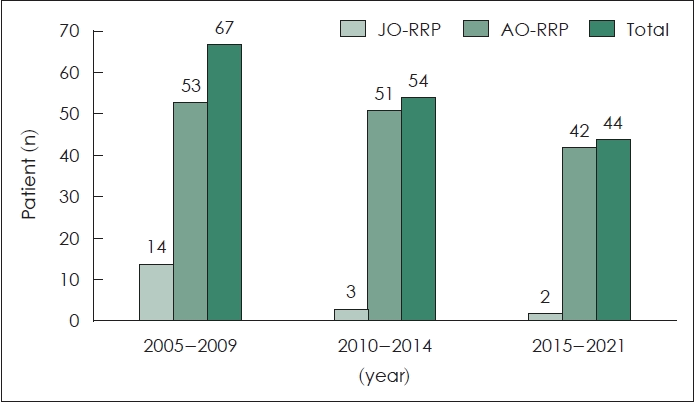
Temporal distribution of RRP cases treated at our institution. RRP, recurrent respiratory papillomatosis; JO-RRP, juvenile-onset RRP; AO-RRP, adult-onset RRP.
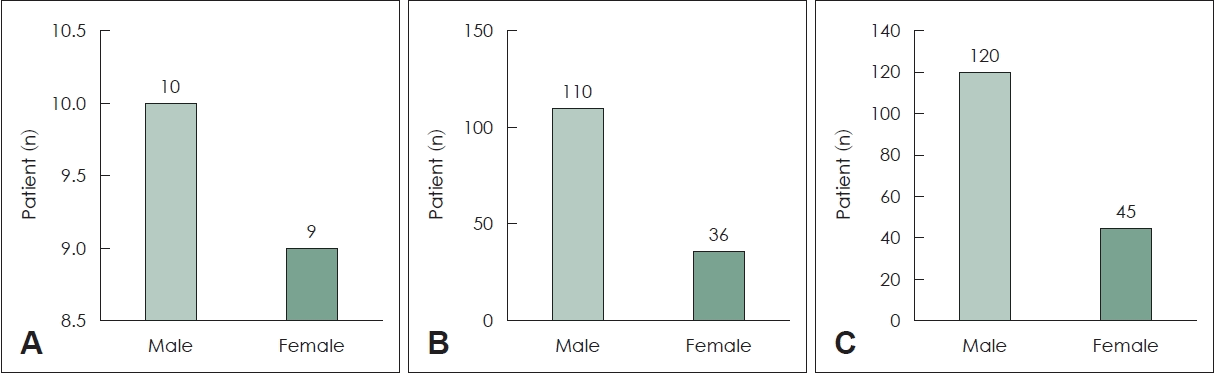
Sex distribution in JO-RRP (A), AO-RRP (B), and total (C) patients. RRP, recurrent respiratory papillomatosis; JO-RRP, juvenileonset RRP; AO-RRP, adult-onset RRP.
CO2 lasers were used in 79.4% of patients, PDL in 27.9%, and KTP lasers in 23.6%. Because most patients underwent multiple surgeries, more than one type of laser was often used. In addition to surgical resection, 66.7% of patients received intralesional cidofovir injections, and 39.4% underwent HPV vaccination. Other clinical characteristics are summarized in Table 1. During the study period among AO-RRP, 36 patients (24.7%) didn’t achieve remission. Subglottic spread occurred in 24 patients (16.4%), tracheotomy was performed in 2 patients (1.4%), laryngeal stenosis developed in 28 patients (19.2%), and malignant transformation occurred in 6 patients (4.1%).
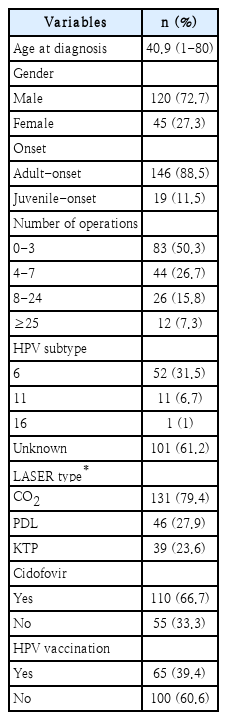
Patient demographics and disease characteristics
While there is currently no standardized criterion for remission, this study defined remission as a state requiring no surgical intervention for RRP for at least 12 months after the final treatment. Subglottic extension was defined as the direct intraoperative visualization of subglottic extension via microscopic or endoscopic examination. Laryngeal stenosis was defined as persistent laryngeal airway stenosis observed postoperatively due to scarring, webs, or synechiae. The presence of malignant transformation was determined based on the histopathological results of tissue obtained during surgery. And, major complications were defined as the need for tracheotomy, laryngeal stenosis requiring surgical intervention, malignant transformation, and subglottic extension.
When comparing JO-RRP and AO-RRP, the JO-RRP group demonstrated significantly worse disease course and complication profiles. None of the JO-RRP patients achieved remission, whereas approximately 75.3% of AO-RRP patients achieved remission. In addition, subglottic spread occurred in 89.5% of JO-RRP patients compared with 16.4% in AO-RRP patients. Tracheotomy was also much more frequent in JO-RRP patients (36.8%) than in AO-RRP patients (1.4%) (Table 2).
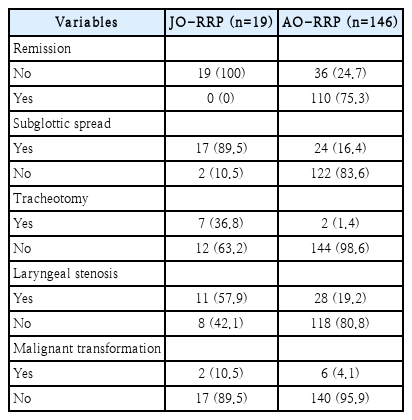
Complications between JO-RRP and AO-RRP group
Candidate factors evaluated included operation burden, follow-up duration, tracheotomy and whether adult onset or Juvenile.
In the crude association analysis, all candidate factors were significantly associated with subglottic or tracheal spread, laryngeal stenosis, and tracheotomy; however, major complications overall were significantly associated with tracheotomy (Table 3-Panel A).
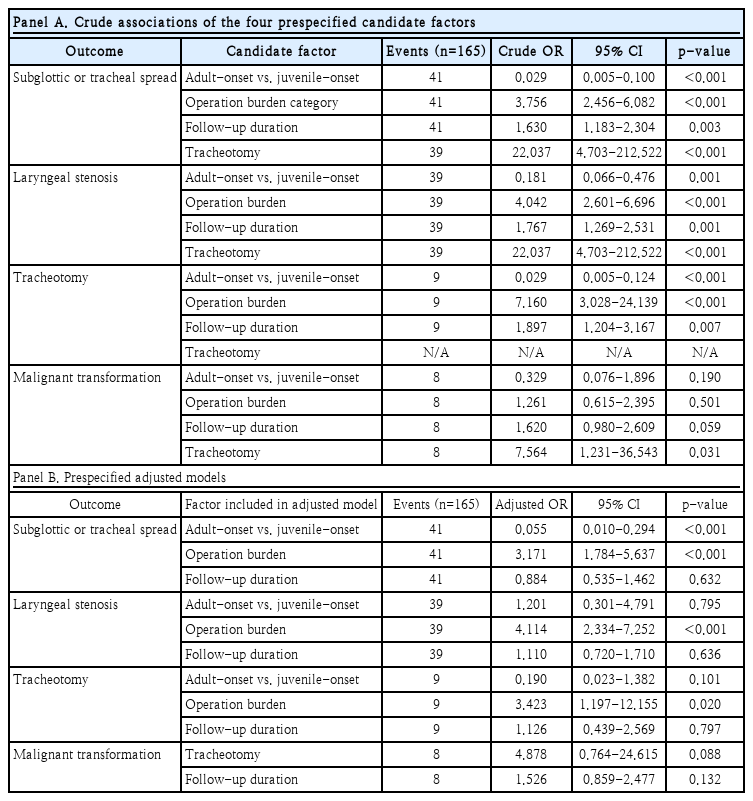
Crude and adjusted associations between candidate factors and major complications in patients with RRP
In the prespecified adjusted model, subglottic or tracheal spread maintained a significant association only with age at onset and surgical burden, whereas both laryngeal stenosis and tracheotomy showed significant associations solely with surgical burden (Table 3-Panel B).
Discussion
RRP is caused by HPV infection, most commonly HPV subtypes 6 and 11, although high-risk subtypes such as 16, 18, 31, 33, and 39 have also been implicated [10,11]. Among the 64 patients for whom HPV subtype information was available in this study, 52 patients were associated with HPV subtype 6, 11 patients with subtype 11, and 1 patient with subtype 16.
When the study period was divided into three intervals, a marked decrease in number of JO-RRP patients treated at our institution and a gradual decrease in number of AO-RRP patients treated at our institution were observed over time. This trend may be associated with the HPV vaccination program introduced in Korea in 2016 as part of the national health insurance system. In this study, we observe no gender difference in JO-RRP, whereas AO-RRP occurred significantly more often in males, which may be related to sexual transmission of HPV.
Although RRP is the most common benign laryngeal tumor in both children and adults, there is still no definitive curative treatment. Surgical excision remains the primary treatment modality, and cold instruments, microdebriders, and lasers have all been utilized [12,13]. The choice of surgical tool or laser type generally depends on institutional preference and surgeon experience. Microdebriders are generally advantageous for efficient removal of bulky lesions. Although CO2 lasers have been widely used, angiolytic lasers such as PDL and KTP lasers are increasingly preferred. Because angiolytic lasers are selectively absorbed by hemoglobin and induce selective photoangiolysis, they reduce bleeding when removing highly vascularized lesions such as papillomas. Furthermore, because these are fiber-based lasers, they are advantageous for removing lesions in curved anatomical areas such as the subglottic region. When combined with a fiberscope equipped with a side channel, they can also be used to remove intrabronchial lesions.
Patients with RRP often experience recurrent disease and repeated surgeries over long treatment periods, resulting in major complications such as laryngeal stenosis, subglottic spread, and malignant transformation. Tracheotomy should be avoided whenever possible; however, it may become unavoidable in cases of severe airway compromise. All major complications mentioned above occurred significantly more frequently in the JO-RRP group. Multivariate analysis demonstrated that onset age and number of surgeries were statistically significant risk factors for major complications. Because JO-RRP patients experience higher recurrence rates, repeated surgical interventions likely contribute to increased complication rates. These findings are consistent with previous studies reporting poorer prognosis in JO-RRP [14,15].
In this study, the absence of remission and the frequent occurrence of subglottic spread and laryngeal stenosis in JORRP patients suggest that early disease onset significantly influences its adverse prognosis. In particular, the high tracheotomy rate and frequent lower airway involvement observed in JO-RRP reflect the aggressive clinical course of the disease.
Multivariate analysis identified the number of surgeries as a marker of cumulative disease burden for major complications, supporting the possibility that repeated surgical trauma and tissue remodeling contribute to complication development. Tracheotomy and repeated surgeries are highly likely to serve as indicators reflecting disease severity, a prolonged disease course, lower respiratory tract involvement, and airway obstruction. Therefore, active surveillance appears to be necessary for patients with a high disease burden. This study has several limitations. First, its retrospective nature and single-center design may restrict the generalizability of the findings to broader populations. Second, the potential for selection bias cannot be entirely ruled out. Finally, slight treatment heterogeneity may have existed over the study period.
In conclusion, in the treatment of RRP, preventing secondary complications is as important as controlling gross disease. Disease onset age, number of surgeries, and tracheotomy were thought to be associated with major complications. In patients with these risk factors, clinicians should pay particular attention to preventing complications and detecting them at an early stage.
Notes
Acknowledgments
None
Author Contribution
Conceptualization: Young Min Park. Data curation: all authors. Formal analysis: all authors. Funding acquisition: Young Min Park. Investigation: Dae Hyun Kim. Methodology: Dae Hyun Kim, Young Min Park. Project administration: Young Min Park. Resources: Young Min Park. Software: Dae Hyun Kim, Young Min Park. Supervision: Young Min Park. Validation: Young Min Park. Visualization: Young Min Park. Writing—original draft: Dae Hyun Kim. Writing—review & editing: Jae-Yol Lim, Young Min Park.